
Blog
A Practical Buyer’s Guide: 5 Mistakes to Avoid with Chai Tea Bags in 2026

Abstract
This article provides a comprehensive examination of selecting high-quality chai tea bags in the contemporary market of 2026. It moves beyond superficial taste preferences to establish a framework for critical evaluation, addressing five common consumer mistakes: ignoring the quality of the black tea base, overlooking the freshness and composition of the spice profile, accepting ambiguous “natural flavors,” employing improper brewing techniques, and disregarding the material and form of the tea bag itself. By integrating historical context, the chemistry of flavor extraction, and practical consumer guidance, the text aims to cultivate a more discerning approach. It analyzes the distinct contributions of various tea origins and spices, critiques industry labeling practices, and offers methodical instructions for achieving an authentic and satisfying brew. The ultimate purpose is to empower the reader with the knowledge to differentiate between mediocre and exceptional chai tea bags, transforming a simple purchase into a well-informed and rewarding sensory experience.
Key Takeaways
- Examine the spice blend for whole, identifiable pieces, not just dust.
- Prioritize a robust black tea base like Assam for a balanced flavor.
- Read ingredient lists carefully to avoid ambiguous “natural flavors.”
- Simmer your chai tea bags with milk and sweetener for authentic taste.
- Choose pyramid-shaped, non-plastic sachets for better infusion.
- Understand that the bag’s material can influence the final flavor.
- Proper storage in an airtight container preserves the aromatic spices.
Table of Contents
- The Allure of Chai: Deconstructing a Global Phenomenon
- Mistake #1: Ignoring the Tea Base – The Foundation of Flavor
- Mistake #2: Overlooking the Spice Profile – The Heart of Chai
- Mistake #3: Falling for “Natural Flavors” and Artificial Additives
- Mistake #4: Using Improper Brewing Techniques
- Mistake #5: Disregarding the Bag Itself – Material and Form
- Elevating Your Chai Ritual: Beyond the Basic Brew
- Frequently Asked Questions (FAQ)
- Conclusion
- References
The Allure of Chai: Deconstructing a Global Phenomenon
The experience of chai is a deeply evocative one, capable of transporting us through its complex aroma alone. It is more than a mere beverage; it is a composition, a symphony of scent and taste that speaks of warmth, comfort, and a rich cultural tapestry. When you hold a cup of well-made chai, the first sensation is often the fragrant steam, carrying notes of sweet cinnamon, pungent ginger, and the floral perfume of cardamom. This is not a simple, monolithic flavor. It is a layered narrative that unfolds on the palate, beginning with the malty robustness of black tea, followed by the crescendo of spices, and resolving into a creamy, satisfying finish. To understand how to choose the best chai tea bags, we must first develop a language and an appreciation for this intricate sensory world. We must learn to ask not just “does it taste good?” but “what story is it telling?”
From ‘Masala Chai’ to the Global Teacup: A Brief History
The journey of what the Western world calls “chai” is a fascinating story of cultural adaptation and transformation. The word “chai” itself simply means “tea” in Hindi and many other languages, a linguistic inheritance from the Persian “chāy.” The beverage we associate with the term is more accurately called “masala chai,” which translates to “spiced tea.” Its origins are steeped in the traditions of Ayurveda, an ancient system of holistic medicine from India, where herbal decoctions, or ‘kashayam’, have been used for thousands of years for their therapeutic properties.
The introduction of black tea into this equation is a more recent development, tied to the history of British colonialism in India. In the early 20th century, the British-owned Indian Tea Association actively promoted tea consumption within India to expand its domestic market. Indian vendors, however, adapted the British preparation style (tea with milk and sugar) by incorporating local spices. This not only made the beverage more flavorful and familiar to the Indian palate but also helped to stretch the costly tea leaves. The resulting masala chai, sold by street vendors known as ‘chaiwallahs’, became an integral part of daily life across the subcontinent—a symbol of hospitality, a pause in a busy day, a source of comfort and energy. The migration of this beloved drink to the global stage, and its subsequent packaging into convenient chai tea bags, represents the latest chapter in its long and storied evolution.
The Sensory Experience: Why We Crave Aromatic Spiced Tea
Our deep-seated attraction to aromatic spiced tea is rooted in a complex interplay of physiology, psychology, and memory. The spices central to masala chai—cinnamon, cardamom, cloves, ginger, and black pepper—are rich in volatile aromatic compounds. When hot water is added, these compounds are released, traveling from the cup to the olfactory receptors in our nose. This direct pathway to the limbic system, the brain’s center for emotion and memory, is why the scent of chai can trigger such powerful feelings of comfort and nostalgia (Dalton, 2002).
The experience on the tongue is equally complex. The robustness of the black tea provides a tannic, slightly astringent foundation, a canvas upon which the spices paint their flavors. Ginger and black pepper introduce a gentle, warming heat (piquancy), which is beautifully balanced by the sweet, woody notes of cinnamon and the complex, citrusy-floral character of cardamom. Clove adds a medicinal, almost pungent sweetness that lingers. When combined with the creaminess of milk and the balancing effect of a sweetener, these individual notes coalesce into a harmonious whole. This balance of bitter, sweet, spicy, and creamy creates a uniquely satisfying mouthfeel and flavor profile that engages the full spectrum of our taste perception. It is this multi-layered sensory engagement that elevates a cup of chai from a simple drink to a profound experience.
Chai in 2026: The Modern Pursuit of Authenticity and Convenience
In 2026, the demand for chai is more widespread than ever, but so is the confusion surrounding it. The marketplace is saturated with options, from artificially flavored syrups and powders to a vast array of chai tea bags. This proliferation speaks to our collective desire for the comfort that chai promises, yet it also presents a challenge: how do we find authenticity in a world of convenience? The modern consumer is no longer content with a beverage that merely mimics the flavor of chai. There is a growing movement towards understanding the origins of our food, demanding transparency in ingredients, and seeking experiences that feel genuine and wholesome.
The chai tea bag sits at the nexus of this tension between authenticity and convenience. It offers a shortcut to a traditionally labor-intensive process, but that shortcut should not come at the cost of quality. The challenge for the discerning consumer is to learn how to read the signals—to look past the marketing and evaluate the contents of the bag itself. It involves shifting our perspective from that of a passive consumer to an active participant in our tea ritual. It requires us to develop the skills to assess the quality of the tea, the freshness of the spices, and the integrity of the overall product. This guide is dedicated to that pursuit, offering a clear path to navigating the world of chai tea bags and finding a product that honors the rich tradition of masala chai while fitting seamlessly into our modern lives.
Mistake #1: Ignoring the Tea Base – The Foundation of Flavor
One of the most prevalent errors in selecting chai tea bags is the complete disregard for the tea itself. We become so focused on the promise of “spice” that we forget the “masala” is meant to enhance the “chai.” The black tea is not a mere vessel for the spices; it is the very foundation of the beverage. A weak, stale, or low-quality tea base results in a drink that is hollow and unbalanced, tasting more like spicy water than a rich, integrated brew. The character of the black tea—its maltiness, its astringency, its inherent body—provides the essential structure that supports and harmonizes with the complexity of the spice blend. Without a strong foundation, the entire flavor profile collapses.
Why the Black Tea Matters More Than You Think
Imagine trying to build a beautiful house on a foundation of sand. No matter how exquisite the materials or skilled the craftsmanship of the structure, it will ultimately lack stability and integrity. The same principle applies to chai. The black tea provides the crucial element of tannins, a group of polyphenolic compounds that contribute bitterness and astringency (or “briskness”) to the brew. This astringency is not a flaw; it is a feature. It provides a counterpoint to the sweetness of other spices and the richness of milk, creating a balanced and dynamic flavor experience.
A high-quality black tea, such as a robust Assam, contributes deep, malty notes that add layers of complexity. These flavors mingle with the spices, creating a cohesive and satisfying whole. In contrast, a low-quality tea, often made from the “dust” and “fannings” left over from the processing of whole-leaf teas, lacks these complex flavor compounds. It provides a one-dimensional bitterness without the accompanying malty depth. When you use such a tea for chai, the spices have nothing to anchor to. The result is a disjointed taste where the spices feel like they are floating on top of the beverage rather than being integrated within it. A quality tea base ensures that your chai has body, depth, and a lingering, pleasant finish.
Assam vs. Ceylon vs. Keemun: A Comparative Analysis
Not all black teas are created equal, and their suitability for a chai blend varies significantly based on their regional characteristics, or terroir. Understanding the profiles of the most common black teas used in chai tea bags can empower you to make a more informed choice. Many premium brands, like those from , often specify the origin of their tea base, which is a strong indicator of quality.
| Tea Type | Origin | Flavor Profile | Role in Chai |
|---|---|---|---|
| Assam | Assam, India | Strong, bold, malty, full-bodied, high in tannins. | The classic and most traditional choice. Its robustness stands up to strong spices and milk, providing a powerful, malty backbone that prevents the chai from tasting watery or weak. |
| Ceylon | Sri Lanka | Brisk, crisp, citrusy, medium-bodied. | A brighter alternative. It creates a lighter, more “brisk” chai where the spices, particularly citrusy notes like cardamom, might shine through more clearly. It can be less forgiving with milk. |
| Keemun | Anhui, China | Toasty, wine-like, fruity, with hints of smoke and orchid. | An unconventional but interesting choice. Its subtle complexity can create a more nuanced and less traditional chai. It pairs well with spices like cinnamon and ginger but may be overpowered by a very heavy spice blend. |
As the table illustrates, an Assam base is often the gold standard for a traditional, powerful masala chai. Its inherent strength and malty character are the perfect foil for the bold spices and the addition of milk and sugar. When a package of chai tea bags proudly declares “Assam” as its base, it is signaling a commitment to a classic and robust flavor profile.
Identifying a Weak or Stale Tea Base in a Tea Bag
Even without a clear label of origin, there are ways to assess the potential quality of the tea base. The primary enemy of tea is time and exposure to air, which leads to oxidation and the loss of volatile flavor compounds. Stale tea loses its complexity and develops a flat, dusty, or even papery taste.
First, consider the aroma of the dry tea bag. Before you are overwhelmed by the spices, try to detect the underlying scent of the tea. Does it smell rich, malty, or even slightly floral? Or does it smell like little more than dry paper or dust? A lack of a distinct tea aroma is a significant red flag.
Second, look at the contents if possible. While many chai tea bags are opaque, some premium brands use semi-transparent sachets. If you can see the tea, look for uniformity in particle size. While tea bags use smaller pieces than loose-leaf tea, a blend that looks like fine powder or “dust” will infuse too quickly, releasing a wave of bitterness (tannins) without the corresponding complex flavors. This results in a harsh, astringent cup. A good tea bag will contain “fannings” or “broken orange pekoe” grades, which are small but still recognizable as pieces of tea leaf, rather than pure dust.
Finally, the ultimate test is in the brewing. Brew a bag without any milk or sugar. Let it cool slightly and taste it. Can you perceive any flavors beyond bitterness? Is there a hint of malt, fruit, or toastiness? If the brew is simply bitter and one-dimensional, you have a weak base. The spices may partially mask this deficiency, but the resulting chai will never achieve the satisfying depth of one built on a quality foundation.
Mistake #2: Overlooking the Spice Profile – The Heart of Chai
If the black tea is the foundation, the spice blend—the masala—is the heart and soul of chai. It is the source of its captivating aroma and its complex, warming flavor. A common mistake is to be seduced by the mere presence of spices without critically evaluating their quality, freshness, and balance. Not all spice blends are created equal. The difference between a vibrant, aromatic chai and a dull, lifeless one often comes down to the integrity of the spices used. An exceptional chai tea bag contains spices that are fresh, fragrant, and thoughtfully proportioned, creating a blend that is harmonious and dynamic.
The “Big Five”: Deconstructing the Core Spices
While recipes for masala chai can vary immensely by region, family, and even personal preference, a classic blend typically revolves around a core group of five spices. Understanding the individual contribution of each is the first step toward appreciating the art of the blend. Many purveyors, including and , build their blends around these foundational flavors.
- Cinnamon (Dalchini): Often the most forward flavor, cinnamon provides a sweet, woody warmth. True cinnamon (Cinnamomum verum) from Sri Lanka has a more delicate and complex flavor, while the more common Cassia (Cinnamomum cassia) is bolder and spicier. Both are used effectively in chai.
- Cardamom (Elaichi): Known as the “Queen of Spices,” cardamom offers a complex aroma that is simultaneously floral, citrusy, spicy, and minty. Green cardamom is typically used in chai for its vibrant and nuanced flavor. It is often the most expensive spice in the blend and a key indicator of quality.
- Clove (Laung): Cloves contribute a pungent, sweet, and slightly medicinal flavor. Their dominant compound, eugenol, provides a unique aromatic profile and a slight numbing sensation on the tongue. A little goes a long way, and a well-balanced chai will use cloves to add depth rather than overpower.
- Ginger (Adrak): Fresh or dried ginger provides a pungent, zesty heat that cuts through the richness of the milk and balances the sweetness of other spices. It is essential for the characteristic “warming” quality of chai.
- Black Pepper (Kali Mirch): While it might seem like an odd addition, black peppercorns provide a sharp, piquant kick that enhances the other spices and adds another layer of warmth. According to Ayurvedic principles, piperine, the active compound in black pepper, is also believed to increase the bioavailability of other nutrients (Shoba et al., 1998).
Freshness is Non-Negotiable: Spotting ‘Spice Dust’ vs. Real Pieces
The most critical factor in a spice’s flavor is its freshness. Spices derive their aroma and taste from volatile oils. Once a spice is ground, its surface area increases dramatically, causing these oils to dissipate rapidly. This is why a freshly ground peppercorn is so much more potent than pre-ground pepper powder that has been sitting in a shaker for months.
This principle is paramount when evaluating chai tea bags. Low-quality bags are often filled with pre-ground, powdered spices that may have been milled months or even years prior. This “spice dust” has lost the majority of its volatile oils and contributes little more than a faint, stale flavor and color to the brew.
In contrast, high-quality chai tea bags prioritize freshness by using coarsely crushed or kibbled spices. When you inspect such a tea bag, you should be able to identify small pieces of cinnamon bark, crushed cardamom pods or seeds, and visible bits of dried ginger. These larger pieces retain their essential oils far more effectively. When they are steeped in hot water, these oils are released, creating the vibrant, multi-dimensional aroma and flavor that defines exceptional chai. If you open a box of chai tea bags and are not immediately greeted by a powerful, complex spicy aroma, it is a strong sign that the spices inside are past their prime.
A Table of Common Chai Spices and Their Flavor Contributions
To further refine your palate, it is helpful to systematically categorize the flavors that various spices bring to a chai blend. This allows you to better identify what you are tasting and to seek out blends that match your personal preferences.
| Spice | Primary Flavor Compound(s) | Flavor Profile | Sensory Contribution |
|---|---|---|---|
| Cinnamon | Cinnamaldehyde | Sweet, Woody, Spicy | Provides foundational warmth and a perception of sweetness. |
| Green Cardamom | Terpinyl acetate, Cineole | Floral, Citrusy, Minty, Spicy | Adds aromatic complexity and a “high note” to the blend. |
| Cloves | Eugenol | Pungent, Sweet, Medicinal | Contributes deep, lingering aromatic notes and a slight numbing warmth. |
| Ginger | Gingerol, Zingerone | Pungent, Zesty, Peppery | Delivers a sharp, clean heat that cuts through richness. |
| Black Pepper | Piperine | Sharp, Piquant, Earthy | Enhances other spices and provides a distinct, lingering warmth. |
| Star Anise | Anethole | Licorice-like, Sweet | Adds a sweet, aromatic layer similar to fennel. |
| Fennel Seed | Anethole | Sweet, Licorice-like, Anise | Provides a gentle sweetness and aids digestion. |
| Nutmeg | Myristicin, Sabinene | Warm, Nutty, Sweet | Adds a rich, earthy sweetness, often used sparingly. |
Regional Variations: Beyond the Classic Masala Blend
The world of chai is not monolithic. Different regions of India and the world have their own unique interpretations of the classic blend. Exploring these variations can be a delightful journey for any tea lover. A Kashmiri Chai, for instance, often uses green tea as a base instead of black, and includes nuts like almonds or pistachios, with saffron lending a luxurious color and aroma. In some parts of Western India, lemongrass is a popular addition, imparting a bright, citrusy fragrance. Some modern blends might incorporate less traditional ingredients like vanilla bean, cacao nibs, or even chili for an extra kick.
When choosing chai tea bags, being open to these variations can expand your horizons. However, the same principles of quality apply. Whether the blend includes star anise and fennel or rose petals and orange peel, the ingredients should be fresh, identifiable, and balanced. A quality producer will craft these blends with the same care as a classic masala chai, ensuring that the new additions harmonize with the core of tea and spices, rather than creating a chaotic or artificial-tasting concoction. The goal is always a cohesive and satisfying sensory experience.
Mistake #3: Falling for “Natural Flavors” and Artificial Additives
In our quest for authentic chai, perhaps the most deceptive obstacle is found in the ingredient list itself. The third major mistake is to accept vague terms like “natural flavors” or “chai spice flavor” at face value. These phrases, while sounding innocuous, are often a veil for lower-quality products. They allow manufacturers to create a consistent, powerful flavor profile without having to invest in high-quality, fresh spices. When a product relies on flavoring agents rather than the real ingredients, it fundamentally compromises the integrity and sensory depth of the chai experience. An authentic chai is defined by the complex interplay of real spices, not by a laboratory’s approximation of them.
The Ambiguity of “Natural Flavors”: What Are You Really Drinking?
The term “natural flavor” is a legally defined but often misunderstood term in the food industry. According to the U.S. Food and Drug Administration (FDA), a natural flavor must be derived from a natural source, such as a spice, fruit, vegetable, or other plant or animal material (FDA, 2024). However, the process of creating that flavor can be highly complex, involving extraction, distillation, and the use of various solvents and preservatives. The final product is a concentrated chemical compound that may bear little resemblance to its original source.
In the context of chai tea bags, “natural chai flavor” could be a compound derived from cinnamon, clove, or cardamom, but it has been isolated and concentrated in a lab. The problem is twofold. First, this process strips away the nuance and complexity of the whole spice. A real cinnamon stick contains hundreds of aromatic compounds that contribute to its flavor, whereas a “natural cinnamon flavor” might consist of just one or two dominant compounds. The result is a flavor that is strong but flat, lacking the rich subtlety of the real thing.
Second, the term provides a lack of transparency. The consumer has no way of knowing the specific origin or processing of the flavor. It is often a proprietary blend, a “black box” of ingredients. This reliance on flavoring is frequently a strategy to mask a weak tea base and the absence of actual, costly spices like cardamom. When you see “natural flavors” high on the ingredient list, it is a signal to be skeptical. The finest gourmet tea sachets will always prioritize real, identifiable ingredients over these ambiguous additives.
The Chemical Aftertaste: How Additives Compromise the Chai Experience
Beyond “natural flavors,” some chai tea bags may contain outright artificial flavors. These are compounds created synthetically that are not derived from a natural source. They are cheaper to produce and can deliver a very potent flavor, but they often come with a distinct and unpleasant chemical aftertaste. This aftertaste is a common complaint among those who have tried low-quality flavored teas. It lingers on the palate in a way that is cloying and unnatural, a stark contrast to the clean, pleasant finish of a chai made with real spices.
Other additives to watch for include artificial sweeteners like sucralose or aspartame, which are sometimes added to pre-sweeten the blend. These can impart a strange, metallic sweetness that clashes with the natural flavors of the tea and spices. Soy lecithin is another common additive, used as an emulsifier to help the flavors disperse, but it can be an indicator that the flavors are not naturally integrated.
The presence of these additives fundamentally alters the nature of the beverage. It shifts it from a wholesome, natural infusion of tea and spices into a more processed food product. The experience becomes less about savoring the nuances of nature and more about consuming a manufactured flavor profile. This is the antithesis of the mindful and authentic tea ritual that many of us seek.
Reading the Label: A Practical Guide to Ingredient Transparency
Becoming a discerning chai consumer requires developing the habit of meticulously reading the ingredient list. It is the single most reliable source of information about what is truly inside your chai tea bag.
Here is what to look for:
- A Short, Recognizable List: The best chai tea bags will have an ingredient list that reads like a recipe. You should see terms like “black tea,” “cinnamon,” “cardamom,” “ginger,” “cloves,” and “black pepper.” The more identifiable the ingredients, the better.
- The Order of Ingredients: Ingredients are listed by weight, from most to least. If “black tea” is the first ingredient, followed by a list of real spices, that is a good sign. If “natural flavor” appears before the actual spices, it suggests that the flavor is primarily coming from the additive, not the real ingredients.
- Absence of Fillers: Look out for fillers like chicory root or carob powder. While not necessarily harmful, they are sometimes used to add bulk and a perception of richness to a blend that is lacking in quality tea and spices.
- Organic Certification: While not a guarantee of flavor, organic certification does ensure that the tea and spices were grown without synthetic pesticides and fertilizers. For many consumers, this is an important consideration for both personal health and environmental reasons. Brands like often highlight their organic ingredients, aligning with a wellness-focused consumer base.
By treating the ingredient list as a primary tool for evaluation, you can cut through the marketing claims and make a choice based on the actual substance of the product. This empowers you to select a chai that is not only delicious but also aligned with a preference for natural, transparent, and high-quality ingredients.
Mistake #4: Using Improper Brewing Techniques
You can purchase the most exquisite, high-quality chai tea bags in the world, filled with robust Assam tea and fresh, kibbled spices, and still end up with a disappointing cup. The fourth critical mistake lies in the brewing process itself. Many of us treat a chai tea bag like any other tea, simply steeping it in a mug of hot water for a few minutes. This approach fails to recognize the unique requirements of chai and is the primary reason homemade chai often tastes weak and insipid compared to the rich, creamy brew served in a good café or by a chaiwallah. Proper brewing is not merely about infusion; it’s about extraction and emulsion. It requires the right temperature, the right timing, and the crucial inclusion of milk and sweetener directly in the brewing process to unlock the full spectrum of flavor.
The Water Temperature Fallacy: Why Boiling Isn’t Always Best
With most black teas, the standard advice is to use water just off the boil, around 95-100°C (203-212°F). This high temperature is necessary to properly extract the complex flavor compounds and tannins from the tea leaves. However, when brewing chai tea bags directly in a mug, using aggressively boiling water can sometimes be counterproductive. The fine particles of tea and spice in a bag infuse very quickly. Water that is too hot can “shock” the leaves, leading to a rapid release of tannins and a resulting bitterness that can overpower the more delicate spicy notes.
A more nuanced approach is to use water that is just beginning to show small bubbles (simmering) or has been left to cool for about a minute after boiling. This slightly lower temperature, around 90-95°C (194-203°F), allows for a more gentle and balanced extraction. It gives the volatile oils from the spices a chance to release without being immediately cooked off, and it coaxes the flavor from the tea leaves more slowly, resulting in less initial bitterness and a more harmonious brew. This is a small adjustment, but it can make a noticeable difference in the final balance of the cup.
To Steep or to Simmer? Adapting Brewing for Tea Bags
The fundamental difference between a weak cup of chai and a rich one often comes down to this choice: steeping versus simmering.
- Steeping: This is the passive method of placing a tea bag in a cup and pouring hot water over it. It relies solely on diffusion for flavor extraction. While convenient, it is often insufficient for chai. The whole and kibbled spices in a quality tea bag require more time and agitation to release their full flavor than the tea leaves do. A simple 5-minute steep may extract the tea’s color and some of the spice’s surface flavor, but the deep, essential oils remain locked within.
- Simmering: This is the active, traditional method. It involves gently heating the tea and spices in a liquid over a period of time. This combination of sustained heat and gentle motion is far more effective at extracting the deep flavors from the spices. To adapt this for a tea bag, you can use a small saucepan on the stovetop. Place the tea bag(s) in a mixture of water and milk and bring it to a gentle simmer (not a rolling boil) for at least 5-7 minutes. The constant, gentle heat works to fully extract the oils from the cinnamon, cloves, and cardamom, while the motion of the liquid ensures a thorough infusion. This method more closely replicates the traditional chaiwallah’s technique and is the single most effective way to achieve a robust flavor from chai tea bags.
The Role of Milk and Sweeteners: Unlocking True Chai Character
In the West, we often think of adding milk and sugar as an afterthought, something done to a finished cup of tea. With chai, this is a fundamental misunderstanding. Milk and sweetener are not just additions; they are integral components of the brewing process.
The fat in milk (dairy or plant-based) plays a crucial chemical role. Many of the aromatic compounds in spices like cardamom and cinnamon are fat-soluble. Brewing the chai tea bag directly in a milky liquid allows these compounds to be extracted and emulsified, resulting in a richer, more rounded flavor and a creamier mouthfeel. The proteins in milk also bind with some of the tea’s tannins, which mellows the astringency and creates a smoother, less bitter taste (Pflughoeft, 2017). This is why chai simmered in milk has a depth and creaminess that can never be achieved by simply adding a splash of cold milk to a cup of steeped chai tea.
Sweetener, whether it’s sugar, honey, or jaggery, also plays a critical role beyond simply adding sweetness. It helps to balance the bitterness of the tea and the pungency of the spices. A small amount of sweetness can actually enhance the perception of the spicy notes, making them taste more vibrant and distinct. The key is to add the sweetener during the simmering process, allowing it to fully dissolve and integrate into the brew.
A Step-by-Step Guide to the Perfect Cup from a Chai Tea Bag
- Choose Your Vessel: Use a small saucepan or pot.
- Create the Liquid Base: For one strong cup, use a ratio of approximately 1/2 cup of water to 3/4 cup of milk. Using some water initially helps to extract the water-soluble compounds from the tea before the milk is added.
- Initial Infusion: Place the water and your chai tea bag in the saucepan. Bring to a very gentle simmer. Let it infuse for about 2 minutes. You will see the water turn a dark amber color.
- Add Milk and Sweetener: Pour in the milk and add your desired amount of sweetener (start with 1-2 teaspoons). Stir gently to dissolve the sweetener.
- Simmer and Extract: Bring the mixture back to a gentle simmer. Do not let it boil over. Allow it to simmer for at least 5-7 minutes, or longer for a more intense flavor. The liquid should thicken slightly and become deeply fragrant. The color will transform into a rich, creamy tan.
- Serve: Pour the chai from the saucepan into your mug. The tea bag can be squeezed gently with a spoon to release the last of the flavorful liquid before being discarded.
- Enjoy: Savor the rich, aromatic, and perfectly balanced cup of chai you have created.
By adopting this active, integrated brewing method, you honor the tradition of masala chai and allow the high-quality chai tea bags you’ve carefully selected to perform to their fullest potential.
Mistake #5: Disregarding the Bag Itself – Material and Form
In the detailed examination of tea and spices, it is easy to commit the fifth mistake: overlooking the physical container. The tea bag is not just a passive holder of ingredients; its material, shape, and construction have a direct and significant impact on the quality of the final brew. The bag acts as the interface between the dry ingredients and the hot water, and its design can either facilitate or hinder proper infusion. Furthermore, as consumer awareness has grown in 2026, concerns about the health and environmental impact of tea bag materials, particularly microplastics, have become a crucial part of the purchasing decision. Choosing a well-designed bag made from a safe, neutral material is the final step in ensuring a perfect and responsible cup of chai.
Paper vs. Silk vs. Nylon: How Bag Material Affects Infusion
The material of a tea bag influences two key aspects of brewing: water flow and flavor neutrality.
- Paper Bags: The most traditional and common tea bag material is bleached or unbleached paper, often made from abacá pulp. While inexpensive, paper bags have significant drawbacks. The fibers are densely packed, which can restrict water flow and prevent the tea leaves and spices from fully expanding and infusing. This can lead to a less flavorful, weaker brew. Additionally, some paper bags, particularly those that are bleached, can impart a subtle but noticeable papery or chemical taste to the tea, interfering with the delicate flavors of the chai.
- Nylon or PET Sachets: Many premium brands moved to “silken” sachets to address the flaws of paper. These are typically made from food-grade plastics like nylon or polyethylene terephthalate (PET). Their main advantage is their porous, mesh-like structure, which allows for excellent water flow and ample room for ingredients to expand. This results in an infusion that is much closer to that of loose-leaf tea. However, the use of petroleum-based plastics in a hot beverage has raised significant health and environmental concerns.
- PLA (Polylactic Acid) “Silk” Sachets: In response to the concerns about nylon, the industry has widely adopted PLA, a bioplastic derived from plant sources like corn starch or sugarcane. These are often marketed as “silk,” “soilon,” or “mesh” bags. PLA offers the same excellent infusion properties as nylon but is biodegradable under specific industrial composting conditions. It is generally considered a more sustainable and safer alternative, as it does not leach microplastics in the same way as nylon. When you are looking for top-tier chai tea bags, seeking out those made from PLA is a wise choice for both flavor and peace of mind.
The Shape of Flavor: Pyramid vs. Flat Sachets
The geometry of the tea bag is just as important as its material. The evolution from the flat, rectangular bag to the pyramid sachet was a major innovation in the tea industry.
- Flat Bags: The classic flat, dual-chambered bag offers limited space. The tea and spices are compressed, preventing them from tumbling freely and interacting fully with the water. This leads to an inefficient and often incomplete extraction of flavor. It is a design born of economy, not of a desire for quality infusion.
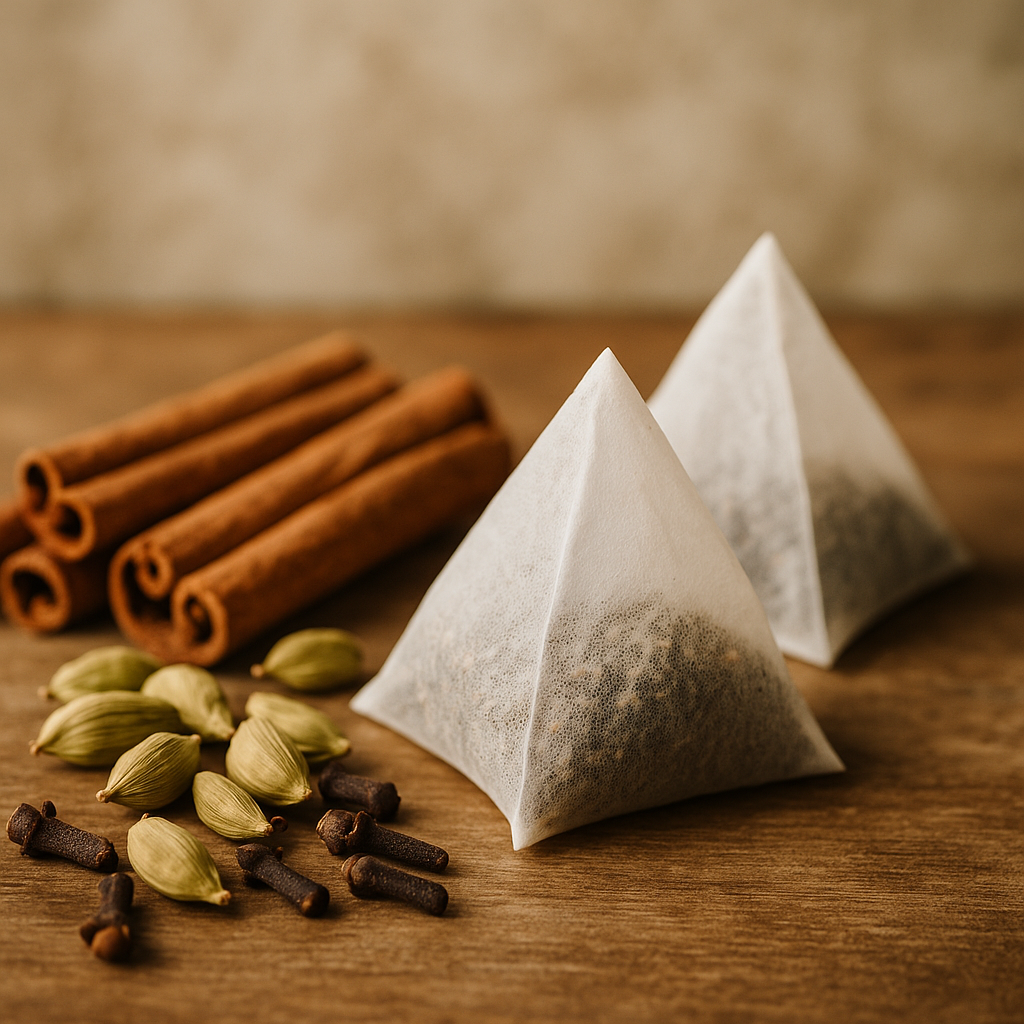
- Pyramid Sachets: The tetrahedral, or pyramid, shape provides significantly more internal volume. This allows the tea leaves and, crucially for chai, the kibbled spices to fully hydrate, expand, and move around. This “toss and tumble” action within the bag ensures that the water can circulate freely around every ingredient, leading to a much faster, more complete, and more flavorful infusion. The pyramid shape effectively creates a miniature infuser basket, allowing the ingredients to perform almost as well as if they were loose in the pot. For a complex blend like chai, where you need to extract flavors from both leaf and dense spice pieces, the pyramid shape is unequivocally superior.
Microplastics in Tea Bags: A Growing Concern in 2026
One of the most significant conversations in the tea world in recent years has been about microplastics. A 2019 study by researchers at McGill University revealed that a single plastic (nylon or PET) tea bag steeped at brewing temperature could release billions of microplastic and nanoplastic particles into the cup (Hernandez et al., 2019). While the long-term health effects of ingesting these particles are still being studied, the findings have understandably caused widespread concern among consumers.
This research has accelerated the shift away from nylon and PET bags toward more stable and natural alternatives. As a consumer in 2026, it is prudent to be aware of this issue. Look for brands that are transparent about their bag materials. The best options are:
- PLA (Corn Starch) Bags: As mentioned, these are the most common high-quality, plastic-free alternatives.
- Paper Bags (Unbleached): If choosing paper, opt for unbleached versions that are free of staples and plastic-based sealants (some bags are heat-sealed with polypropylene).
- Loose-Leaf Chai: Of course, the most certain way to avoid this issue entirely is to brew loose-leaf chai, though this moves beyond the convenience of chai tea bags.
By paying attention to the bag’s shape and material, you are not just ensuring a better-tasting cup of chai; you are also making a conscious choice about your health and the environment. It is the final piece of the puzzle in the pursuit of the perfect, responsibly sourced brew.
Elevating Your Chai Ritual: Beyond the Basic Brew
Once you have mastered the art of selecting and brewing the perfect cup from high-quality chai tea bags, a new world of possibilities opens up. The rich, spicy, and aromatic concentrate you create is a versatile base for a variety of delightful beverages and culinary pairings. Elevating your chai ritual is about integrating this beautiful beverage into your life in creative and mindful ways, transforming it from a simple morning drink into a source of daily pleasure and comfort.
Creating a Chai Latte at Home
A café-style chai latte is a luxurious treat that is surprisingly simple to make at home once you have a strong chai base. The key is creating a frothy, velvety milk foam to top your brew.
- Brew a Concentrated Chai: Follow the stovetop simmering method described earlier, but use a slightly higher ratio of tea bags to liquid. For a very strong base, use two chai tea bags for every one cup of liquid (e.g., 1/2 cup water, 1/2 cup milk). Simmer for a solid 7-10 minutes to create a potent, spicy concentrate.
- Froth Your Milk: While the chai is simmering, heat about 1/2 cup of milk separately. You can use a microwave or a small pot. The ideal temperature for frothing is around 65°C (150°F)—hot to the touch, but not simmering. To create foam, you have several options:
- Electric Frother: This is the easiest method, creating perfect foam in seconds.
- French Press: Pour the hot milk into a French press and vigorously pump the plunger up and down for about 30 seconds until the milk has doubled in volume and formed a thick foam.
- Mason Jar: Pour the hot milk into a Mason jar, seal it tightly, and shake vigorously for about 45-60 seconds.
- Assemble Your Latte: Pour the strained, concentrated chai into your favorite mug, filling it about halfway. Gently pour the frothed milk over the top, using a spoon to hold back the thickest part of the foam until the end. Spoon the remaining foam on top.
- Garnish (Optional): For a final flourish, sprinkle a tiny pinch of cinnamon or nutmeg over the foam.
Pairing Chai with Foods
The complex flavor profile of chai—spicy, sweet, malty, and creamy—makes it a wonderful companion to a variety of foods. The key is to find pairings that either complement or provide a pleasant contrast to its flavors.
- Sweet Pairings: The spices in chai are naturally at home with many baked goods. Think of pairing your cup with a simple shortbread cookie, a buttery scone, a slice of carrot cake, or a classic apple crumble. The spices in the food will echo the spices in the tea, creating a harmonious experience.
- Savory Pairings: Don’t be afraid to pair chai with savory snacks. In India, it is commonly enjoyed with savory pastries like samosas. The rich, spicy tea cuts through the oiliness of the fried pastry beautifully. It also pairs surprisingly well with a simple, buttery cheese on a cracker.
- Breakfast Pairings: A morning cup of chai is a perfect match for a bowl of oatmeal or porridge. The creamy, spicy notes of the tea enhance the simple, earthy flavors of the oats. It is also wonderful alongside a piece of toast with butter and cinnamon sugar.
The Mindful Practice of Tea Drinking
Beyond lattes and food pairings, the most profound way to elevate your chai ritual is to approach it with mindfulness. In a world of constant distraction, the simple act of preparing and drinking a cup of tea can become a powerful anchor to the present moment.
Take the time to engage all your senses. As the chai simmers on the stove, close your eyes and focus on the evolving aroma. Notice the sweet notes of cinnamon, the sharp scent of ginger, the floral perfume of cardamom. As you pour the finished brew, observe its rich, creamy color. Before you take the first sip, hold the warm mug in your hands and feel its comforting heat.
When you drink, do so slowly. Try to identify the individual flavors—the malty tea, the different spices, the creamy milk, the balanced sweetness. Pay attention to the feeling of warmth spreading through your body. This simple, five-minute practice can be a form of meditation, a way to quiet the mind, reduce stress, and cultivate a sense of gratitude and peace. By treating your cup of chai not as a means to an end (caffeine) but as an experience in itself, you unlock its true potential for comfort and well-being.
Frequently Asked Questions (FAQ)
What is the real difference between chai and masala chai?
The terms are often used interchangeably in the West, but they have distinct meanings. “Chai” is the Hindi word for “tea.” “Masala” is the Hindi word for a “spice mix.” Therefore, “masala chai” literally translates to “spiced tea.” When you order “chai” in India, you will get masala chai. When you order a “chai tea latte” in a Western café, you are ordering a milky, sweetened version of masala chai. In essence, the beverage everyone thinks of as “chai” is technically masala chai.
How much caffeine is in a typical chai tea bag?
The caffeine content in a chai tea bag depends primarily on the type and amount of black tea used. A typical 8-ounce cup of chai made from a standard tea bag will contain approximately 40-70 milligrams of caffeine. This is roughly half the amount found in a standard cup of coffee (which has about 95-120 mg) but slightly more than a typical cup of plain black tea. The L-theanine present in the tea works synergistically with the caffeine to provide a calmer, more sustained energy boost without the jitteriness sometimes associated with coffee.
Can I re-steep my chai tea bags?
While you can re-steep chai tea bags, it is generally not recommended if you are seeking the full flavor experience. The first infusion, especially when simmered with milk, extracts the majority of the complex flavors from both the tea and the spices. A second steep will result in a significantly weaker, more watery brew that lacks the richness and aromatic punch of the first. The tea flavor may come through, but the nuanced spice notes will be largely absent.
Why does my homemade chai taste weak compared to a cafe’s?
This is a very common issue and it almost always comes down to the brewing method. Most cafés make their chai from a highly concentrated syrup or by simmering a large batch of loose-leaf tea and spices in milk for an extended period. If you are simply steeping a chai tea bag in a mug of hot water for a few minutes and then adding a splash of milk, your brew will taste weak in comparison. To achieve a café-style richness at home, you must follow the stovetop simmering method outlined in this guide, using both milk and water in the pot and allowing it to gently simmer for at least 5-7 minutes.
Are organic chai tea bags really better?
“Better” can be subjective, but organic certification provides tangible assurances. It guarantees that the tea leaves and spices were grown without the use of synthetic pesticides, herbicides, or fertilizers. For many people, this is preferable for personal health and environmental reasons. In terms of flavor, organic farming practices can sometimes lead to healthier soil and more robust plants, which may result in a more flavorful product, though this is not a universal rule. Ultimately, choosing organic is a personal preference, but it is often aligned with brands that also prioritize overall ingredient quality and transparency.
What is the best way to store chai tea bags to maintain freshness?
The enemies of tea and spices are air, light, heat, and moisture. To preserve the volatile oils that give your chai its aroma and flavor, proper storage is essential. The cardboard box the tea bags come in is not ideal for long-term storage. The best practice is to transfer the tea bags to an opaque, airtight container and store it in a cool, dark place like a pantry or cupboard. Avoid storing them near the stove or in the refrigerator, where temperature fluctuations and strong odors can degrade the quality.
Conclusion
The journey toward a perfect cup of chai is one of sensory education and mindful practice. It begins with the understanding that a simple chai tea bag is not a commodity to be chosen at random but a composition to be critically appreciated. We have moved from a passive acceptance of what is offered to an active engagement with the product, armed with the ability to deconstruct its components. We now understand that the malty strength of the tea base is the non-negotiable foundation, that the heart of the chai beats in the freshness of its spices, and that the integrity of the brew is compromised by the ambiguity of artificial additives.
We have learned that the brewing process itself is an art—that simmering is superior to steeping and that milk and sweetener are not afterthoughts but integral participants in the creation of flavor. Finally, we recognize that even the humble vessel, the tea bag itself, plays a crucial role in the final outcome, with its shape and material dictating the quality of the infusion and reflecting a commitment to health and sustainability.
By avoiding these five common mistakes, you are no longer just a consumer of chai; you are a curator of your own tea experience. You are empowered to look past the alluring packaging and marketing promises to find the authentic soul of masala chai, conveniently captured but not compromised. The goal is not merely to avoid a bad cup but to consistently create a truly exceptional one—a brew that is rich, aromatic, balanced, and deeply comforting. This knowledge transforms the daily ritual of making tea into a moment of connection: to a rich history, to distant lands, and to the simple, profound pleasure of a well-crafted cup.
References
Dalton, P. (2002). Olfaction. In H. Pashler & S. Yantis (Eds.), Stevens’ handbook of experimental psychology: Vol. 1. Sensation and perception (3rd ed., pp. 691–746). John Wiley & Sons.
Food and Drug Administration. (2024). CFR – Code of Federal Regulations Title 21, Part 101, Section 101.22. U.S. Food and Drug Administration.
Hernandez, L. M., Xu, E. G., Larsson, H. C. E., Tahara, R., Maisuria, V. B., & Tufenkji, N. (2019). Plastic teabags release billions of microparticles and nanoparticles into tea. Environmental Science & Technology, 53(21), 12300–12310.
Pflughoeft, K. (2017, June 13). The chemistry of tea. The University of Wisconsin-Madison Department of Chemistry.
Shoba, G., Joy, D., Joseph, T., Majeed, M., Rajendran, R., & Srinivas, P. S. S. R. (1998). Influence of piperine on the pharmacokinetics of curcumin in animals and human volunteers. Planta Medica, 64(04), 353–356.
Sporked. (n.d.). The Best Chai Tea Bags, Ranked. https://sporked.com/article/best-chai-tea/
Stash Tea. (n.d.). Warming Chai Spice Black Tea Bags.
Zen’s Tea House. (n.d.). Home.

