
Blog
Mastering China Tea in 2026: A Practical Guide to 6 Essential Types & Brewing

Abstract
This article presents a comprehensive examination of China tea, tracing its origins from the legendary discovery by Emperor Shen Nong to its contemporary global significance. It provides a systematic framework for understanding the six primary categories of Chinese tea: green, white, yellow, oolong, black, and dark tea (hēichá). The analysis focuses on the pivotal role of processing, particularly oxidation and microbial fermentation, in creating the vast spectrum of flavors, aromas, and textures that characterize these teas. The discussion extends beyond mere classification to explore the unique terroir of famous production regions and the specific cultivars that define renowned varieties like Longjing, Silver Needle, and Da Hong Pao. By elucidating the chemistry and artistry behind each tea type, the text aims to equip both novices and connoisseurs with the knowledge to appreciate the nuances of China tea. A practical guide to brewing techniques is included to help readers properly extract the complex profiles of these beverages, transforming the act of tea consumption into a mindful sensory experience.
Key Takeaways
- All six major tea types originate from the same plant, Camellia sinensis.
- Processing, especially the control of oxidation, determines a tea’s final category.
- Each tea family possesses a unique profile of flavor, aroma, and mouthfeel.
- Brewing with the correct water temperature and time is vital for taste.
- Exploring the diverse world of authentic China tea deepens cultural appreciation.
- Proper storage in airtight, dark containers preserves tea freshness and flavor.
- A tasting journal can help you identify and refine your personal preferences.
Table of Contents
- A Glimpse into the Ancient Origins of Tea
- Deconstructing the Six Families of China Tea
- The Verdant World of Green Tea (绿茶, Lǜchá)
- The Subtle Elegance of White Tea (白茶, Báichá)
- The Ephemeral Grace of Yellow Tea (黄茶, Huángchá)
- The Artful Complexity of Oolong Tea (乌龙茶, Wūlóngchá)
- The Robust Character of Black Tea (红茶, Hóngchá)
- The Earthy Depth of Dark Tea (黑茶, Hēichá)
- The Ritual of Brewing: A Practical Guide
- Frequently Asked Questions (FAQ)
- A Lifelong Journey in a Cup
- References
A Glimpse into the Ancient Origins of Tea
To comprehend the soul of China tea, one must first travel back not merely in distance but in time, to a point where legend and history intertwine. The narrative of tea begins in the mists of antiquity, rooted in the lands that now constitute modern China. The most enduring origin story, a blend of folklore and imperial record, attributes the discovery to the mythological emperor Shen Nong around 2737 B.C. (Numitea.com). As the tale goes, Shen Nong, a ruler renowned for his wisdom regarding agriculture and herbal medicine, was boiling water for sanitation when a few leaves from a wild Camellia sinensis bush drifted into his pot. Intrigued by the fragrant aroma and the delicate color of the resulting infusion, he tasted it and found it both refreshing and restorative.
While the story of Shen Nong provides a poetic beginning, archaeological evidence offers a more tangible timeline. Residues of tea have been found in the tomb of a Han Dynasty emperor dating back to the 2nd century B.C., suggesting its use as a medicinal beverage for the elite. It was during the Tang Dynasty (618–907 A.D.), however, that tea transitioned from a medicinal tonic to a beloved daily beverage and an object of refined cultural appreciation. During this era, Lu Yu, a scholar often revered as the “Sage of Tea,” penned The Classic of Tea (茶经, Chájīng). This seminal work was the world’s first monograph dedicated entirely to tea, codifying everything from its cultivation and processing to the proper methods of brewing and consumption. Lu Yu’s work elevated tea from a simple drink to an art form, a path toward spiritual refinement and social harmony.
From the Tang Dynasty onward, the culture and processing of China tea evolved dramatically. The Song Dynasty (960–1279 A.D.) saw the rise of powdered tea, whipped into a frothy consistency in a ritual that would later inspire the Japanese tea ceremony. The Ming Dynasty (1368–1644 A.D.) marked a pivotal shift toward the brewing of whole, loose leaves, a practice that remains the standard today. It was also during this period that tea artisans began experimenting with different processing methods, leading to the development of the distinct categories we recognize now. This long, rich history is not just a backdrop; it is infused in every cup. When we engage with China tea, we are not merely consuming a beverage but participating in a tradition thousands of years in the making, a liquid narrative of culture, artistry, and connection to the natural world.
Deconstructing the Six Families of China Tea
At the heart of understanding the immense diversity within the world of China tea lies a single, elegant truth: nearly all of it springs from one species, the Camellia sinensis plant (zeniatea.com). The astonishing variety of teas—from the bright, grassy notes of a green tea to the deep, earthy character of a Pu-erh—is not a result of different plants but of human ingenuity. The identity of a tea is forged in the moments after its leaves are plucked, through a series of carefully controlled processing steps. The most consequential of these is oxidation.
Imagine slicing an apple and leaving it on the counter. The browning that occurs as the flesh is exposed to air is a form of enzymatic oxidation. In a similar way, when tea leaves are bruised, rolled, or broken, enzymes within the leaf cells are exposed to oxygen, initiating a chemical transformation. This process changes the leaf’s color, aroma, and flavor profile. The art of the tea master lies in their ability to precisely encourage, manage, or halt this oxidation to achieve a desired outcome. This mastery gives rise to the six fundamental families of China tea: Green, White, Yellow, Oolong, Black, and Dark Tea.
Each family represents a point on a spectrum of processing, creating a logical system for navigating this complex world. Thinking about these categories as a progression can be a helpful mental exercise for the aspiring tea enthusiast. We begin with teas that are minimally processed and move toward those that undergo more profound transformations.
| Tea Category | Chinese Name (Pinyin) | Oxidation Level | Key Processing Step | Common Flavor Profile | Representative Tea |
|---|---|---|---|---|---|
| Green Tea | 绿茶 (Lǜchá) | 0% (Unoxidized) | Heating (Pan-firing/Steaming) | Grassy, vegetal, nutty, fresh | Longjing (Dragon Well) |
| White Tea | 白茶 (Báichá) | 5-15% (Slightly Oxidized) | Withering and Drying | Delicate, floral, melon, soft | Baihao Yinzhen (Silver Needle) |
| Yellow Tea | 黄茶 (Huángchá) | 10-20% (Slightly Oxidized & Fermented) | “Sealing Yellow” (Men Huang) | Mellow, sweet, smooth, gentle | Junshan Yinzhen |
| Oolong Tea | 乌龙茶 (Wūlóngchá) | 15-85% (Partially Oxidized) | Shaking/Bruising & Roasting | Floral to fruity to roasty | Tie Guan Yin, Da Hong Pao |
| Black Tea | 红茶 (Hóngchá) | 100% (Fully Oxidized) | Rolling & Full Oxidation | Malty, honeyed, cocoa, robust | Keemun, Lapsang Souchong |
| Dark Tea | 黑茶 (Hēichá) | Post-fermented | Piling & Aging (Microbial) | Earthy, woody, mushroomy, smooth | Shou Pu-erh, Liu Bao |
This framework is more than just a list; it is a map. It allows one to navigate the vast offerings with a sense of direction. When you taste a tea from each of these families, you are not just experiencing different flavors; you are tasting the direct results of different philosophies and techniques of craftsmanship.
The Verdant World of Green Tea (绿茶, Lǜchá)
Green tea represents the most direct expression of the Camellia sinensis leaf, a taste of the plant in its most unadulterated form. The defining characteristic of green tea is that it is unoxidized. The primary goal of the tea artisan is to preserve the leaf’s natural greenness and fresh, vibrant character. To achieve this, the process of oxidation must be halted swiftly and decisively after the leaves are harvested and briefly withered. This crucial step, known as “kill-green” (杀青, shāqīng), involves applying heat to denature the enzymes responsible for browning.
The Art of Halting Time: Pan-Firing vs. Steaming
The method used for the “kill-green” process imparts a profound and distinct character to the final tea, creating two major stylistic branches within the green tea family. In China, the predominant method is pan-firing. Leaves are heated in large woks, a technique that requires immense skill to heat the leaves evenly without scorching them. This process lends Chinese green teas their characteristic toasty, nutty, and sometimes sweetly vegetal flavor profile. It is a gentler heating method that coaxes out a mellow sweetness.
In contrast, the Japanese method typically involves steaming the leaves. This application of moist heat is faster and more intense, perfectly preserving the vibrant, emerald-green color of the leaves. It results in a flavor profile that is more boldly vegetal, often described as grassy, marine, or umami-rich. Tasting a pan-fired Chinese Longjing alongside a steamed Japanese Sencha is a revelatory experience, showcasing how a single divergence in processing creates two entirely different sensory worlds from the same foundational material.
Flavors and Famous Varieties of Chinese Green Tea
The landscape of Chinese green tea is vast and regionally diverse. Each famous tea is a product of its unique terroir—the combination of soil, climate, altitude, and cultivar—and the specific crafting traditions of its home.
One of the most celebrated Chinese green teas is Longjing (龙井), or Dragon Well, from the hills surrounding West Lake in Hangzhou, Zhejiang province. Its flat, sword-shaped leaves are a hallmark of its meticulous pan-firing process. A high-quality Longjing offers a remarkably smooth, mellow liquor with a distinctive flavor of toasted chestnuts and sweet green beans, and a long, refreshing finish.
Another famous variety is Biluochun (碧螺春), or Green Snail Spring, from the Dongting Mountain region in Jiangsu. This tea is made from tiny, tender buds and leaves that are covered in fine white down. The leaves are rolled into tight spirals resembling snail shells. When brewed, they unfurl to release an intensely aromatic, fruity, and floral fragrance, with a flavor that is both brisk and deeply sweet.
For those interested in exploring the world of green tea, starting with these classic examples provides a solid foundation. The experience they offer is one of freshness and vitality, a direct connection to the living plant and the spring season in which they are harvested.
Brewing for Freshness
Brewing green tea correctly is paramount to enjoying its delicate character. Because the leaves are unoxidized and tender, they are sensitive to high temperatures. Using water that is too hot will scorch the leaves, destroying their subtle complexities and releasing excessive bitterness and astringency.
A general guideline for Chinese green tea is to use water well below boiling, typically between 75-85°C (167-185°F). Steeping times should be short, often starting at around 1-2 minutes for the first infusion. High-quality green teas can be re-steeped multiple times, with each infusion revealing a new layer of flavor. Paying attention to these parameters allows the tea to express its true nature: fresh, sweet, and vibrantly alive.
The Subtle Elegance of White Tea (白茶, Báichá)
If green tea is a taste of spring freshness, white tea is the embodiment of minimalist grace. It is the least processed of all the traditional tea families, a testament to the idea that sometimes the greatest artistry lies in restraint. The philosophy behind white tea is to intervene as little as possible, allowing the leaf to express its inherent delicacy. Originating in the Fuding and Zhenghe areas of China’s Fujian province, white tea is traditionally made from the youngest, most tender buds and leaves of the tea plant, harvested in the early days of spring.
The Craft of Patience: Withering and Drying
The processing of white tea is deceptively simple, consisting of only two steps: withering and drying. There is no “kill-green” step to halt oxidation, nor is there any intentional rolling or shaping of the leaves. After harvesting, the leaves are spread out thinly, either indoors on bamboo racks or outdoors in gentle sunlight, and left to wither naturally over an extended period, sometimes for up to 72 hours.
During this slow withering process, a very slight amount of natural oxidation occurs, softening any potential green astringency and developing the tea’s characteristic soft, mellow profile. The tea artisan’s skill lies in carefully monitoring the ambient temperature and humidity to ensure the leaves dry evenly without spoiling. This gentle, patient handling preserves the fine, silvery-white hairs (known as hao) that cover the young tea buds, which give the tea its name and its beautiful appearance.
Profiles of Delicacy: Silver Needle and White Peony
The world of white tea is primarily defined by a few key grades, determined by the standard of leaves picked. The most prized and delicate is Baihao Yinzhen (白毫银针), or Silver Needle. This tea consists solely of unopened, plump tea buds, which are uniformly covered in silvery down. Because it is made only from buds, the yield is low and the labor is intensive, making it a highly sought-after tea. When brewed, Silver Needle produces a pale, luminous liquor with a remarkably smooth, viscous texture. Its flavor is incredibly subtle and nuanced, with notes of sweet hay, light melon, apricot, and a delicate, lingering floral sweetness. It is a tea that demands quiet contemplation.
A step down in grade but still of exceptional quality is Bai Mudan (白牡丹), or White Peony. White Peony is made from a blend of the terminal bud and the first one or two leaves below it. The inclusion of leaves adds more body and structure to the brew compared to Silver Needle. The liquor is typically a deeper golden color, and the flavor is fuller and more forward, with notes of dried flowers, honey, and a gentle earthiness, while still retaining the characteristic smoothness and sweetness of white tea.
Brewing for Nuance
To appreciate the subtle character of white tea, careful brewing is essential. Like green tea, it is sensitive to high temperatures. However, because it is slightly more oxidized, it can handle slightly warmer water. A good starting point is between 80-90°C (176-194°F). Steeping times can be longer than for green teas, often beginning at 2-3 minutes. The delicacy of white tea can be easily overpowered by aggressive brewing, so a gentle approach yields the best results. A well-brewed cup of white tea is a lesson in subtlety, offering a soft, comforting, and deeply satisfying experience.
The Ephemeral Grace of Yellow Tea (黄茶, Huángchá)
Yellow tea is perhaps the rarest and least understood category of China tea. It occupies a fascinating space between green and white tea, sharing some characteristics with both but possessing a unique identity forged by an additional, signature processing step. Historically, yellow tea was an imperial tribute tea, reserved for the emperor and his court, which may account for its relative obscurity in the wider world. Its production is limited to just a few regions in China, and the skill required to craft it properly is possessed by only a handful of tea masters.
The Secret of “Sealing Yellow”
The initial processing of yellow tea closely mirrors that of green tea. The leaves are harvested, withered, and then undergo a “kill-green” step to halt most enzymatic oxidation. However, what sets yellow tea apart is the subsequent step known as mènhuáng (闷黄), which translates to “sealing yellow” or “smothering yellow.”
After the initial heating, while the leaves are still warm and moist, they are wrapped in special cloth or paper, or sometimes piled, and left to rest for a period. This gentle, warm, and humid environment allows for a slight, non-enzymatic oxidation to occur. This process mellows the grassy, vegetal notes characteristic of green tea, resulting in a flavor profile that is exceptionally smooth, sweet, and devoid of any astringency. The leaves and the resulting liquor take on a distinctive yellowish hue, giving the tea its name. This smothering step is often repeated multiple times, requiring careful judgment from the tea master to develop the desired character without souring the leaves.
A Mellow, Sweet Profile
The taste of yellow tea is often a surprise to those who have never experienced it. It lacks the bright, brisk character of green tea and the overt floral delicacy of white tea. Instead, it offers a unique profile that is often described as sweet, clean, and smooth, with notes of toasted corn, sweet bread, or bamboo. The aroma is gentle and comforting. It is a tea that feels both refined and accessible, with a round, full mouthfeel and a pleasant, lingering sweetness.
The most famous yellow tea is Junshan Yinzhen (君山银针), or Junshan Silver Needle, from an island in Dongting Lake, Hunan province. Like the white tea of the same name, it is made exclusively from plump, downy buds. The meticulous mènhuáng process gives these buds a golden-yellow color and a flavor that is incredibly refined, with a light, sweet fragrance and a smooth, almost brothy texture. It is a true connoisseur’s tea and a window into a rare and disappearing art form.
Brewing for Smoothness
Brewing yellow tea is similar to brewing high-quality green tea. Cooler water temperatures, around 80-85°C (176-185°F), are recommended to preserve its delicate sweetness. It can be steeped for slightly longer than green tea, around 2-3 minutes for the first infusion. The goal is to coax out its mellow, sweet character. When brewed correctly, yellow tea provides a uniquely satisfying experience, a taste of imperial history and a masterclass in subtle processing.
The Artful Complexity of Oolong Tea (乌龙茶, Wūlóngchá)
Oolong tea represents the vast and exciting middle ground of the tea world, a category defined by its partial oxidation. Spanning a range from lightly oxidized (around 15%) to heavily oxidized (up to 85%), oolong teas offer an unparalleled diversity of flavor and aroma, showcasing the pinnacle of tea-making artistry. The name Wūlóng (乌龙) translates to “Black Dragon,” a fitting descriptor for the dark, twisted leaves of many traditional oolong varieties. This family of tea is primarily produced in China’s Fujian and Guangdong provinces, as well as in Taiwan.
The Dance of Oxidation: Shaking and Roasting
The creation of oolong tea is one of the most technically demanding processes in the tea world. After the leaves are harvested and withered, they undergo a repeated process of gentle agitation. Traditionally, this is done by shaking the leaves on large bamboo platters or tumbling them in cylindrical bamboo drums. This bruising action breaks the cell walls at the edges of the leaves, initiating oxidation in those areas while leaving the center of the leaf largely intact.
The tea master must skillfully alternate between periods of bruising and periods of rest, carefully managing the extent of oxidation to achieve the desired aromatic profile. After the target oxidation level is reached, the leaves are pan-fired at a high temperature to halt the process. They are then rolled and shaped—either into tightly balled spheres or long, twisted strips—and finally dried and, in many cases, roasted. This final roasting can range from very light, to preserve floral notes, to very heavy, to develop deep, caramelized, and nutty flavors.
A Spectrum of Flavors: From Floral to Roasty
The wide range of oxidation and roasting levels creates a spectrum of oolong styles, which can be broadly grouped into two main categories.
Lightly Oxidized Oolongs: These teas, often called “green oolongs,” are closer to green tea in character. They are typically oxidized to between 15-30% and are often lightly roasted or left unroasted. The most famous example is Tie Guan Yin (铁观音), or Iron Goddess of Mercy, from Anxi county in Fujian. Traditionally rolled into tight, jade-colored balls, these leaves unfurl in hot water to release an intensely fragrant, floral aroma, often compared to orchids, lilac, or gardenia. The flavor is smooth, buttery, and sweet with a long, vibrant finish.
Heavily Oxidized Oolongs: These teas, sometimes called “dark oolongs,” are closer to black tea. They are oxidized to 50% or more and often undergo significant roasting. The quintessential examples are the “rock oolongs” (岩茶, yánchá) from the Wuyi Mountains in northern Fujian. The most legendary of these is Da Hong Pao (大红袍), or Big Red Robe. Its long, dark, twisted leaves produce a rich, amber liquor with a complex flavor profile. Expect warming notes of roasted stone fruit, dark honey, minerals, and a lingering smoky or chocolaty finish. This is a tea with immense depth and power.
Brewing to Unfurl Complexity
Brewing oolong tea, particularly in the traditional Gongfu style, is a ritual designed to unlock its complex, layered character. Because of their tightly rolled or twisted shape, oolong leaves require hot water to fully open up. Boiling or near-boiling water (90-100°C or 194-212°F) is generally recommended.
The Gongfu method uses a high leaf-to-water ratio in a small vessel, such as a gaiwan or a small clay teapot. Infusions are very short, often starting at just 15-30 seconds. This method allows the tea to be steeped many times—sometimes more than ten—with each infusion revealing a subtle shift in the tea’s aroma and flavor. It is a dynamic and engaging way to experience the full narrative arc of a high-quality oolong tea. Exploring the world of oolongs is a journey in itself, and a great way to start is by trying some curated tea selections that showcase this diversity.
The Robust Character of Black Tea (红茶, Hóngchá)
For many in the Western world, black tea is the quintessential tea. Its strong, robust, and comforting flavor forms the basis of popular blends like English Breakfast and Earl Grey. In China, however, this category is known as hóngchá (红茶), which translates to “red tea.” This name does not refer to the color of the dry leaf but to the beautiful reddish-amber hue of the brewed liquor. Chinese black tea is fully oxidized, a process that fundamentally transforms the leaf’s chemistry and creates its characteristic deep flavor profile.
The Complete Transformation: Full Oxidation
The journey of a black tea leaf involves a complete metamorphosis. After harvesting and withering, the leaves are aggressively rolled, twisted, or cut. This process, more intense than the gentle bruising of oolongs, is designed to break down the cell walls thoroughly, exposing the leaf’s enzymes to oxygen and initiating a rapid and complete oxidation.
The leaves are then spread out in a cool, humid environment for several hours to allow this oxidation to run its course. During this time, the green catechins in the leaf are converted into more complex compounds called theaflavins and thearubigins. Theaflavins are responsible for the tea’s bright, brisk character and golden-red color, while thearubigins contribute to its body, depth, and darker reddish-brown tones. The tea master’s job is to stop the oxidation at the precise moment when the desired balance of these compounds has been achieved, which is done by drying the leaves with hot air.
Regional Styles: Keemun, Lapsang Souchong, and Dian Hong
China produces several world-renowned black teas, each with a distinct character shaped by its terroir and specific crafting methods.
Keemun (祁门红茶, Qímén Hóngchá), from Qimen county in Anhui province, is one of China’s most famous black teas. It is celebrated for its complex aromatic profile, which is often described as having notes of wine, fruit, and a hint of pine or smoke, sometimes with a floral, orchid-like fragrance. A high-quality Keemun is smooth and mellow, with a delicate sweetness that sets it apart from more robust black teas from India or Sri Lanka.
Lapsang Souchong (正山小种, Zhèngshān Xiǎozhǒng) is arguably the world’s first black tea, originating from the Wuyi Mountains in Fujian. Its unique and powerful character comes from a final drying step where the leaves are smoked over pinewood fires. This imparts a dramatic and unmistakable smoky aroma and flavor, often compared to campfires, smoked meats, or fine cigars. While its intensity can be polarizing, a traditional Lapsang Souchong offers a deeply warming and savory experience.
Dian Hong (滇红) refers to black teas from Yunnan province, the same region famous for Pu-erh. Made from large-leaf cultivars, Dian Hong teas are known for their beautiful golden tips and a rich, malty, and sweet flavor profile. They often have notes of sweet potato, cocoa, and black pepper, with a full body and a smooth, non-astringent finish.
Brewing for Full-Bodied Flavor
As a fully oxidized and robust tea, black tea is the most forgiving to brew. It can and should be brewed with fully boiling water (100°C or 212°F) to extract its deep flavors. Steeping times typically range from 3 to 5 minutes, depending on the desired strength. While many Chinese black teas are delicate enough to be enjoyed on their own, their robust nature also allows them to stand up well to the addition of milk and sugar, a practice more common in Western tea culture.
The Earthy Depth of Dark Tea (黑茶, Hēichá)
Dark tea, or hēichá, is a category that stands apart from all others. While other teas are defined by their level of enzymatic oxidation, dark tea is defined by an additional process: microbial fermentation. This is a “living tea” that is aged, often for many years, allowing microorganisms like bacteria and fungi to slowly transform the chemical composition of the leaves. This process is similar to the aging of fine wine or cheese, creating a flavor profile that is profoundly earthy, smooth, and complex. The most famous type of dark tea is Pu-erh (普洱茶, Pǔ’ěrchá) from Yunnan province.
The Influence of Time and Microbes
The production of dark tea involves a unique step called “wet piling” or wòdūi (渥堆). After the initial processing to create a base tea (similar to a green tea, called máochá), the leaves are piled up, moistened, and covered. This warm, humid environment encourages the growth of a complex colony of microbes. Over a period of several weeks or months, these microbes ferment the leaves, breaking down catechins and other compounds, which mellows the tea’s astringency and develops its signature earthy character.
This “ripe” or shou (熟) Pu-erh process was developed in the 1970s to accelerate the aging process and replicate the character of traditionally aged “raw” or sheng (生) Pu-erh. Sheng Pu-erh is not subjected to this accelerated fermentation. Instead, the máochá is compressed into cakes and allowed to age naturally over many years, or even decades. Young sheng Pu-erh can be quite bright, floral, and astringent, similar to a potent green tea. As it ages, it slowly ferments, mellowing and darkening, developing deep, complex notes of camphor, aged wood, leather, and dried fruit.
The Taste of the Earth: Sheng vs. Shou Pu-erh
Tasting sheng and shou Pu-erh side-by-side reveals two distinct expressions of fermentation.
Shou (Ripe) Pu-erh: This tea is known for its dark, almost black liquor and a flavor profile that is immediately earthy and smooth. Common tasting notes include damp forest floor, mushrooms, dark chocolate, and a deep, comforting sweetness. It is often described as having a grounding and calming effect. Because its character is developed through accelerated fermentation, it is ready to drink upon release.
Sheng (Raw) Pu-erh: The experience of sheng Pu-erh is a journey through time. A young sheng (1-5 years old) might be vibrant and challenging, with notes of stone fruit, wildflowers, and a noticeable bitterness or astringency. An aged sheng (15+ years old) will have transformed into something entirely different. The liquor will be darker, the bitterness will have mellowed into a profound sweetness, and the flavors will have deepened into a complex symphony of aged wood, medicinal herbs, and a smooth, thick texture.
Brewing to Awaken the Leaves
Dark teas, especially compressed Pu-erh, benefit from a specific brewing approach. It is customary to first “rinse” or “awaken” the leaves. This involves a very brief initial steep (10-15 seconds) with boiling water, which is then discarded. This rinse helps to wash away any dust from storage and, more importantly, begins to open up the compressed leaves, preparing them for proper infusion.
After the rinse, dark teas should be brewed with fully boiling water (100°C or 212°F). As with oolongs, the Gongfu style with short, successive infusions is ideal for exploring their evolving character. The first few steeps might be short (20-30 seconds), with the time gradually increasing for later infusions. A good quality Pu-erh can be steeped a remarkable number of times, offering a long and rewarding tasting session.
The Ritual of Brewing: A Practical Guide
Possessing fine tea is one thing; knowing how to unlock its soul is another. The process of brewing is not a chore but a ritual, a moment of mindful practice that connects you to the leaf and the artisans who crafted it. While the world of Chinese tea brewing can be as simple as a mug and an infuser or as complex as a formal Gongfu Cha ceremony, a few foundational principles will ensure you are tasting the tea as it was meant to be experienced.
The Essential Elements
Three variables form the foundation of a good brew: water, temperature, and time. Mastering their interplay is the key to delicious tea.
Water: Your brewed tea is over 98% water, so its quality is not a trivial detail. Tap water that is heavily chlorinated or high in mineral content can mask the delicate flavors of a fine China tea. The ideal choice is fresh, filtered water. Spring water is also excellent. Avoid distilled water, as a small amount of mineral content is necessary for proper flavor extraction. Always start with fresh, cold water and heat it to the desired temperature. Re-boiling water depletes its dissolved oxygen, which can result in a “flat” tasting brew.
| Tea Type | Recommended Water Temperature | Initial Steep Time | Notes |
|---|---|---|---|
| Green Tea | 75-85°C (167-185°F) | 1-2 minutes | Prone to bitterness if water is too hot. |
| White Tea | 80-90°C (176-194°F) | 2-3 minutes | Delicate; requires a gentle approach. |
| Yellow Tea | 80-85°C (176-185°F) | 2-3 minutes | Brew like a high-quality green tea. |
| Oolong Tea | 90-100°C (194-212°F) | 30 sec – 2 min | Hot water is needed to unfurl rolled leaves. |
| Black Tea | 100°C (212°F) | 3-5 minutes | Robust and forgiving; needs boiling water. |
| Dark Tea (Pu-erh) | 100°C (212°F) | 20-40 seconds | Always rinse the leaves first. |
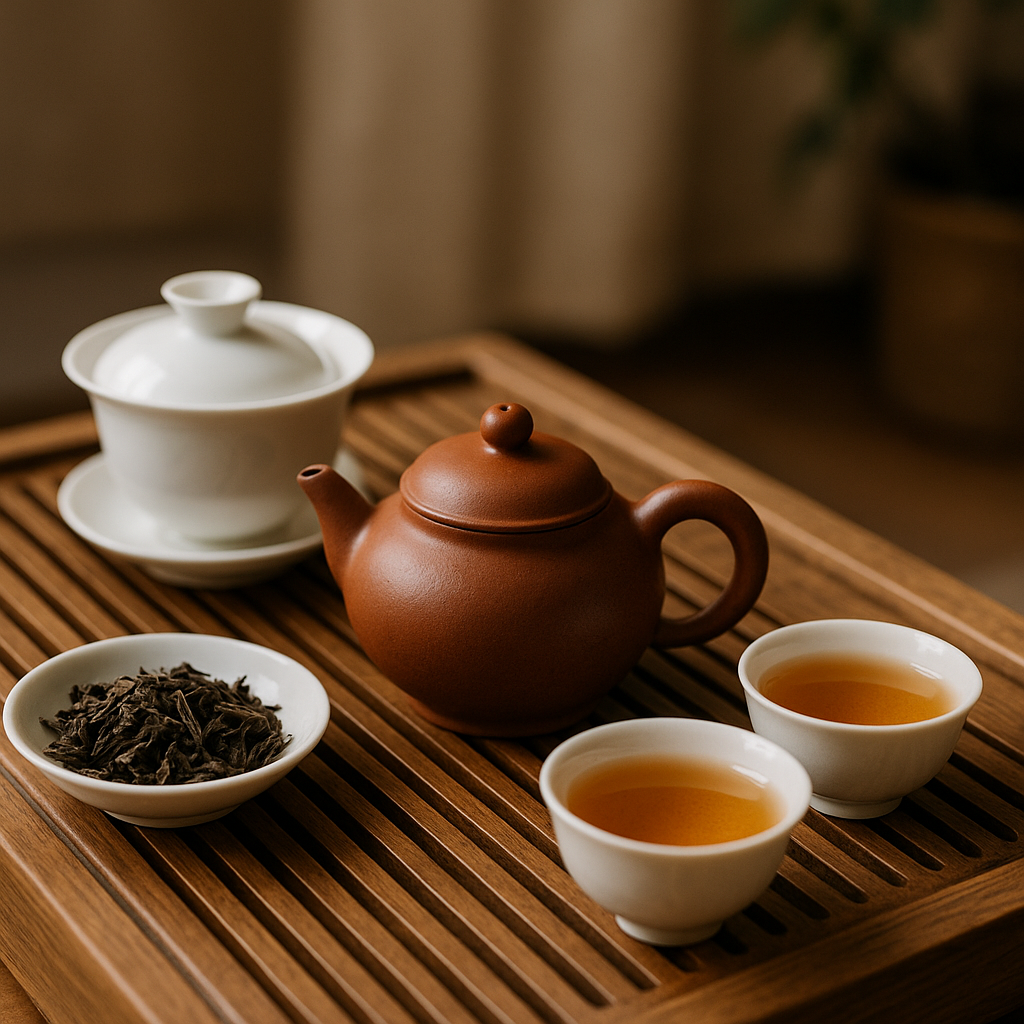
Teaware: While you can certainly brew delicious tea in a simple mug with a basket infuser, investing in a few key pieces can elevate the experience. A gaiwan (盖碗), a lidded bowl, is a versatile and traditional Chinese brewing vessel. It allows you to observe the leaves unfurling, appreciate the aroma trapped under the lid, and control the infusion with precision. It is particularly well-suited for oolong, white, and green teas. For black and Pu-erh teas, a small teapot made of porcelain or unglazed Yixing clay can be wonderful. Yixing clay is porous and, over time, will absorb the oils of the tea, enhancing subsequent brews.
The Gongfu Cha Approach
Gongfu Cha (功夫茶) translates to “making tea with skill.” It is not a rigid ceremony but a mindful approach to brewing that emphasizes a high leaf-to-water ratio and short, multiple infusions. This method allows you to experience the full evolution of a tea’s flavor profile.
- Prepare: Gather your teaware (gaiwan or small pot), a sharing pitcher (gong dao bei), small tasting cups, and your chosen tea.
- Warm the Vessels: Pour hot water into your brewing vessel and cups to pre-warm them. Discard the water. This ensures the brewing temperature remains stable.
- Add the Leaf: Add a generous amount of tea leaves to the warmed pot—enough to cover the bottom, or about 5-7 grams for a standard 100-120ml gaiwan.
- Awaken the Leaves: Pour hot water over the leaves just to cover them and immediately pour it off. This is the “rinse” step, particularly important for compressed Pu-erh and rolled oolongs.
- First Infusion: Refill the vessel with water at the appropriate temperature. Steep for a very short time (e.g., 20-30 seconds).
- Serve: Pour the entire infusion into the sharing pitcher. This ensures that each person receives a brew of equal strength. From the pitcher, serve the tea into the small tasting cups.
- Repeat: Continue with subsequent infusions, gradually increasing the steeping time for each round. Pay attention to how the aroma, flavor, and mouthfeel change with each cup.
This process transforms tea brewing from a simple task into an engaging sensory exploration, a perfect way to appreciate the deep complexities of authentic loose-leaf teas.
Frequently Asked Questions (FAQ)
What is the difference between Chinese green tea and Japanese green tea?
The primary difference lies in the “kill-green” process used to halt oxidation. Chinese green teas are typically pan-fired in a wok, which imparts a gentler, toastier, and nuttier flavor. Japanese green teas are usually steamed, which preserves a more vibrant green color and results in a bolder, more vegetal, and umami-rich flavor profile.
Why is Chinese black tea called “red tea” (hóngchá)?
The name refers to the color of the brewed liquid, which is a rich, reddish-amber hue. In the West, the tea was named “black tea” based on the dark color of the oxidized dry leaves. It is a simple matter of different naming conventions focusing on different aspects of the tea.
Is Pu-erh tea safe to drink? Does it contain mold?
High-quality Pu-erh tea is perfectly safe. The aging process involves microbial fermentation, not spoilage. It relies on a complex colony of beneficial bacteria and yeasts, similar to the cultures used to make yogurt or sourdough bread. Teas that have been improperly stored and have developed harmful mold will have a foul, musty odor and should be discarded. Reputable vendors ensure their Pu-erh is aged in clean, controlled environments.
How much caffeine is in China tea?
All true teas from Camellia sinensis contain caffeine. However, the amount varies significantly based on the tea type, processing, and brewing method. As a very general rule, black teas tend to have the highest caffeine content, followed by oolongs, green teas, and then white teas. However, factors like the specific cultivar and harvest time can also play a large role.
How should I store my loose-leaf tea?
Tea is sensitive to its environment. To maintain freshness, it must be protected from its four enemies: air, light, moisture, and strong odors. The best way to store your tea is in an airtight, opaque container, kept in a cool, dark, and dry place like a pantry or cupboard. Avoid storing it near coffee, spices, or other strong-smelling items.
A Lifelong Journey in a Cup
Embarking on the path of China tea is to begin a journey with no final destination. It is an exploration of geography, a study of botany, and a lesson in history, all contained within the confines of a cup. We began with the legendary discovery by Shen Nong and traced tea’s evolution through the dynasties, seeing how it transformed from a humble medicinal herb into a cornerstone of culture and art. We deconstructed the six great families, understanding that the vast spectrum of flavor—from the verdant freshness of green tea to the earthy depth of Pu-erh—is a testament to the masterful human guidance of natural processes.
To learn the language of tea is to learn to pay attention. It is to notice the difference between the toasty aroma of a pan-fired Longjing and the oceanic scent of a steamed Sencha. It is to feel the buttery texture of a Tie Guan Yin oolong on the palate and to savor the lingering, mineral-sweet finish of a Wuyi rock tea. Adopting a mindful brewing practice, whether it is a simple, quiet moment with a mug or a more involved Gongfu session, elevates the experience from mere consumption to active participation. It is in this focused ritual that the complexities of a fine tea truly reveal themselves.
The knowledge of the six categories provides a map, but the true joy lies in wandering the territory. Each new tea is a new conversation, a new story waiting to be heard. This guide is merely a starting point, an invitation to begin your own personal exploration. The world of China tea is vast, and its rewards are as profound as its history is long.
References
Chen, H., Yu, F., Kang, J., Li, Q., Warusawitharana, H. K., & Li, B. (2023). Quality chemistry, physiological functions, and health benefits of organic acids from tea (Camellia sinensis). Molecules, 28(5), 2339. https://doi.org/10.3390/molecules28052339
Chinatea.com.cn. (n.d.). Chinese tea. Retrieved January 15, 2026, from
Chazhidao.org. (n.d.). Types of Chinese Tea. Retrieved January 15, 2026, from
In Pursuit of Tea. (n.d.). Premium Chinese Tea. Retrieved January 15, 2026, from
Khan, N., & Mukhtar, H. (2018). Tea polyphenols in promotion of human health. Nutrients, 11(1), 39. https://doi.org/10.3390/nu11010039
Numi Tea. (2024, December 10). The ultimate guide to types of tea and their benefits. Retrieved January 15, 2026, from https://numitea.com/blogs/news/the-ultimate-guide-to-types-of-tea-and-their-benefits
Seven Teahouse. (2025, February 14). How to taste tea like a pro: The five essential flavors. Retrieved January 15, 2026, from https://seventeahouse.com/how-to-taste-tea-like-a-pro/
The Tea Spot. (n.d.). Chinese Tea. Retrieved January 15, 2026, from
Wikipedia. (n.d.). Chinese tea. Retrieved January 15, 2026, from
Zeniatea. (2026, January 14). Choosing your first tea sampler: A practical 5-step buyer’s guide for 2026. Retrieved January 15, 2026, from https://zeniatea.com/how-to-choose-a-tea-sampler/

