Blog
A Practical Buyer’s Guide to Chá Pu Erh: 5 Key Factors for Your First Purchase in 2026


Abstract
This guide offers a comprehensive exploration of chá pu erh, a post-fermented tea from Yunnan, China, intended to equip both novices and connoisseurs with the knowledge for informed purchasing and appreciation. The document delineates the fundamental distinction between Sheng (raw) and Shou (ripe) pu erh, examining their unique production processes and resultant flavor profiles that evolve over time. It investigates the critical roles of age, storage conditions, and geographical origin (terroir) in shaping the tea’s character and value. The guide further analyzes the various compressed forms, such as cakes and bricks, and provides practical instructions for preparation. By contextualizing chá pu erh within its cultural and historical framework, this analysis moves beyond simple description to foster a deeper, more nuanced understanding of its complexities. The objective is to demystify this often-intimidating category of tea, making its rich world accessible through a structured examination of the five primary factors a buyer should consider before making a selection in 2026.
Key Takeaways
- Distinguish between Sheng (raw) and Shou (ripe) to match your taste preference.
- Understand that age can enhance complexity, but proper storage is paramount.
- Explore different compressed forms, but start with a sample if unsure.
- Learn about the different regions to understand flavor profile variations.
- Master basic brewing techniques to fully appreciate your chá pu erh.
- Use fresh, filtered water for the purest expression of the tea’s flavor.
- Experiment with brewing parameters; your personal palate is the final judge.
Table of Contents
- Understanding the Core of Chá Pu Erh: A Living Tea
- Factor 1: Sheng (Raw) vs. Shou (Ripe) – Choosing Your Path
- Factor 2: Age and Storage – The Dimension of Time
- Factor 3: Form and Shape – From Loose Leaf to Compressed Cakes
- Factor 4: Terroir and Material – The Soul of the Leaf
- Factor 5: Brewing and Appreciation – Bringing the Tea to Life
- Frequently Asked Questions about Chá Pu Erh
- A Final Thought on the Journey
- References
Understanding the Core of Chá Pu Erh: A Living Tea
To approach the world of chá pu erh is to step into a narrative written in leaves, time, and microbiology. Unlike the more familiar green or black teas, whose character is largely fixed at the moment of production, pu erh is a dynamic, evolving substance. It is perhaps more akin to fine wine or artisanal cheese, where the passage of years and the conditions of the cellar are not merely incidental but are integral to the development of its final, complex identity. This is a tea that breathes, that changes, that tells a story of its past.
What Defines Chá Pu Erh? A Matter of Origin and Process
At its most fundamental level, the identity of chá pu erh is protected by a geographical designation, much like Champagne from France or Parmigiano-Reggiano from Italy. True pu erh must originate from the broadleaf tea variety (Camellia sinensis var. assamica) grown within Yunnan province in southwestern China (TeaSource, 2022). This specific plant varietal, with its large, robust leaves, contains the rich polyphenolic compounds necessary for the deep, transformative processes that define this tea.
After plucking, the leaves undergo a process that sets them on one of two very different paths. They are pan-fired to halt most enzymatic oxidation—a step called “kill-green” (sha qing)—then rolled and sun-dried. The resulting base material is known as “mao cha” (毛茶), or rough tea. It is from this mao cha that all authentic chá pu erh is made. What happens next is what creates the two great families of pu erh: Sheng and Shou. This divergence in processing is the single most important distinction one must grasp when beginning to explore this category of fermented tea.
The Concept of Fermentation vs. Oxidation in Tea
Before we proceed, it is useful to clarify a common point of confusion in the tea world: the terms ‘fermentation’ and ‘oxidation’. Often used interchangeably, they describe distinct biochemical processes.
Oxidation is an enzymatic reaction. It occurs when the enzymes within the tea leaf are exposed to oxygen, for example, after the leaves are rolled or bruised. This process is what turns a green tea leaf into a black tea leaf, changing its color, aroma, and flavor. The process is halted by applying heat, which denatures the enzymes.
Fermentation, in contrast, involves the action of microbes—bacteria, yeasts, and molds. While all tea may have some minor microbial activity, in the context of chá pu erh, this process is intentional and defining. It is the metabolic action of these microorganisms that breaks down compounds in the leaf, creating entirely new flavor and aroma molecules that would not otherwise exist. Shou pu erh undergoes a rapid, controlled microbial fermentation, while Sheng pu erh experiences a much slower, more subtle fermentation over many years of aging (TeaSource, 2022). This microbial transformation is the secret to pu erh’s unique earthy, mellow, and complex character.
Why Yunnan Province is the Heart of Pu Erh
Yunnan is not just a political boundary; it is a unique bioregion that is the cradle of tea itself. The province is home to ancient, wild tea trees, some reputed to be centuries or even over a millennium old. This genetic heritage provides a depth of material unmatched anywhere else in the world. The region’s subtropical highland climate, with its significant temperature fluctuations, misty mountains, and rich, biodiverse soil, creates the ideal conditions for the Camellia sinensis var. assamica plant to thrive.
Furthermore, the very air and environment of Yunnan are suffused with a specific microbiome. The particular strains of bacteria and fungi that drive the fermentation of chá pu erh are native to this region. Attempts to replicate the pu erh process outside of Yunnan have never managed to reproduce the same depth and character, underscoring the profound connection between this tea and its place of origin. It is a true expression of terroir, where the land, the plant, the climate, and the local microbial life are all inextricably woven into the final product.
Factor 1: Sheng (Raw) vs. Shou (Ripe) – Choosing Your Path
Your first and most fundamental choice when selecting a chá pu erh will be between Sheng and Shou. These are not merely different styles; they are two distinct categories of tea with vastly different sensory profiles, aging potential, and histories. Understanding this division is the key to finding a pu erh that you will genuinely enjoy. Think of it as choosing between a crisp, young white wine with aging potential and a rich, smooth, ready-to-drink red.
Sheng Pu Erh: The Slow Transformation
Sheng (生, shēng) pu erh, often translated as “raw” or “green,” is the traditional, older form of pu erh. After the mao cha is produced, it is typically steam-pressed into cakes or other shapes and then left to age naturally. In its youth, a Sheng pu erh is often vibrant, astringent, and potent, with characteristics that can be reminiscent of a strong green tea. It may display notes of apricot, wildflowers, tobacco, and a certain bittersweetness. The color of the brewed tea is typically a pale yellow or golden-green.
The magic of Sheng pu erh lies in its capacity for transformation. Over years and decades, the slow, natural microbial fermentation and oxidation process gradually mellows the tea. The initial astringency and bitterness recede, replaced by a growing smoothness, depth, and complexity. The color of the liquor deepens to a rich amber or orange-red. The flavor profile evolves to include notes of camphor, aged wood, dried fruits, and a characteristic sweetness known as “hui gan” (回甘), a pleasant aftertaste that lingers and develops in the back of the throat. For many collectors, this journey of aging is the ultimate fascination of chá pu erh.
Shou Pu Erh: The Accelerated Journey
Shou (熟, shú) pu erh, also known as “ripe” or “cooked,” is a much more recent innovation, developed in the 1970s by the Kunming Tea Factory. The goal was to create a tea that mimicked the smooth, dark, earthy character of aged Sheng pu erh, but in a fraction of the time. This is achieved through a process called “wo dui” (渥堆), or “wet piling.”
In this process, the mao cha is piled up, moistened, and covered with cloths. The heat and moisture generated within the pile create a perfect environment for rapid microbial fermentation (TeaSource, 2022). Over a period of about 45 to 60 days, factory workers carefully monitor and turn the piles to ensure an even fermentation. This intense process fundamentally alters the tea, breaking down its harsher elements.
The result is a tea that is dark, smooth, and earthy from the very beginning. The brewed liquor is an opaque, deep reddish-brown, almost like coffee. The flavor profile is characterized by notes of damp earth, old books, dark chocolate, mushrooms, and sometimes a hint of sweetness. Shou pu erh is generally much less astringent and bitter than young Sheng, making it very approachable for newcomers. While it does not undergo the same dramatic transformation as Sheng, a well-made Shou can continue to refine and mellow with a few years of aging, losing any “wo dui” fermentation aroma and gaining a cleaner, smoother profile.
A Comparative Table: Sheng vs. Shou at a Glance
To help you visualize the differences, consider the following comparison. This will be a valuable tool as you begin your journey into the world of fermented tea.
| Feature | Sheng (Raw) Pu Erh | Shou (Ripe) Pu Erh |
|---|---|---|
| Process | Natural, slow fermentation over years | Accelerated, controlled “wet piling” fermentation over ~45-60 days |
| Color of Leaves | Green to dark green/brown with age | Dark brown to black |
| Liquor Color | Pale yellow-green (young) to deep orange-red (aged) | Deep, opaque reddish-brown to black |
| Flavor Profile | Floral, fruity, astringent, bittersweet (young); Camphor, wood, dried fruit, mellow (aged) | Earthy, woody, dark chocolate, smooth, sometimes “fishy” or “funky” when young |
| Aroma | Fragrant, sometimes smoky (young); Earthy, medicinal, sweet (aged) | Earthy, damp forest floor, mossy |
| Aging Potential | High; transforms dramatically over decades | Low; refines and smooths over a few years but does not transform |
| Approachability | Can be challenging for beginners when young | Very approachable; smooth and easy to drink |
Factor 2: Age and Storage – The Dimension of Time
With chá pu erh, and particularly with Sheng pu erh, time is an active ingredient. The age of a tea is often prominently displayed and can be a major factor in its price. However, the relationship between age, quality, and value is far from simple. It is a nuanced interplay between the tea’s inherent potential, the years it has rested, and, most critically, the environment in which it was stored.
Does Older Always Mean Better?
There is a pervasive belief that when it comes to pu erh, older is always superior. This is a dangerous oversimplification. While a well-stored, high-quality Sheng pu erh will almost certainly improve with age, gaining depth and shedding its youthful harshness, age cannot turn a poor-quality tea into a masterpiece. A tea made from inferior leaf material will simply become an old, poor-quality tea. Its flaws may mellow, but they will not vanish.
Furthermore, there is a peak to the aging curve. A Sheng pu erh might reach its most expressive and balanced state at 20, 30, or even 50 years, after which it may begin a slow decline, losing its vibrancy and complexity. The optimal age is a matter of the tea’s specific character and personal preference. Some may prefer the vibrant energy of a 10-year-old Sheng, while others seek the profound, contemplative calm of a 40-year-old vintage. For Shou pu erh, the effect of age is more about refinement than transformation. A few years of rest can allow any residual fermentation aroma from the “wo dui” process to dissipate, resulting in a cleaner, smoother, and more integrated cup. Beyond 10-15 years, however, the changes are often minimal.
The Role of Storage Conditions: Humidity and Airflow
The environment where a chá pu erh cake spends its years is arguably more important than its age. The wrong storage can ruin a tea, while the right conditions can elevate it. There are two main schools of thought on pu erh storage, broadly defined as “dry” and “wet.”
Dry storage refers to an environment with relatively low humidity (typically below 70%) and good ventilation. This slows the fermentation process, preserving more of the tea’s original aromatic qualities. Teas aged in this manner tend to develop a clean, fragrant character with notes of camphor and aged wood. This style is typical of places like Kunming or Malaysia.
Wet storage involves higher humidity (often 80% or more), which accelerates the microbial fermentation. This can speed up the “aging” process, making a tea taste older than it is. However, it is a high-risk strategy. If not managed with extreme care, it can easily lead to the growth of harmful molds, resulting in a musty, unpleasant tea that is at best undrinkable and at worst unsafe. Hong Kong and some parts of Guangzhou are famous for this style of storage.
Today, most connoisseurs advocate for a balanced approach: a “natural storage” with moderate humidity (around 65-75%), stable temperature, darkness, and some air circulation to prevent mustiness. The key is to avoid extremes and fluctuations. When buying aged pu erh, knowing its storage history is as important as knowing its production date.
How to Identify a Tea’s Age and Provenance
Determining the age and origin of a pu erh can be a detective story. For newly produced teas from reputable brands, the information is usually reliable. Each cake is often wrapped in a “nei fei” (a small ticket pressed into the cake) and a “da piao” (the large outer wrapper), which contain information about the producer, the year, and sometimes the region.
For older teas, the task becomes much more difficult. Wrappers can be faked, and stories can be fabricated. An experienced taster learns to look for clues in the tea itself. The appearance of the dry leaves, the color and clarity of the brewed liquor, and the specific notes in the aroma and flavor can all provide hints about a tea’s age and storage history. For example, a Sheng tea with a deep red liquor but a still-greenish cast to the steeped leaves might suggest it underwent a period of wet storage. The aroma of a truly old, well-stored tea is clean and deep, not musty or moldy.
For a beginner, the best strategy is to buy from a trusted, transparent vendor who can provide clear information about their sourcing. Starting with younger teas or reputable factory productions from known years is a much safer approach than gambling on a purportedly ancient cake from an unknown source. You can find a thoughtful selection of authentic pu erh teas that provides this transparency, allowing you to begin your collection with confidence.
Factor 3: Form and Shape – From Loose Leaf to Compressed Cakes
Chá pu erh is most famously sold in compressed forms. This tradition arose from historical necessity; compressing the tea into dense cakes, bricks, or other shapes made it easier to transport and trade along the ancient Tea Horse Road. Today, while logistics are less of a concern, the practice continues for both traditional and practical reasons. Compression affects how the tea ages and how it is brewed.
The Traditional Bing Cha (Cake)
The most iconic form of pu erh is the “bing cha” (饼茶), a round, discus-like cake. The standard weight was traditionally 357 grams. This specific weight is not arbitrary; it has its roots in old systems of measurement. Seven of these cakes were typically bundled together into a “tong” (筒), wrapped in bamboo leaves, and a dozen tongs made a “jian” (件), or basket. A 357g cake was a convenient and standardized unit for trade. While other weights are now common (e.g., 100g, 200g, 400g), the 357g bing cha remains the classic format.
Compression into a cake creates a micro-environment. The outer leaves are more exposed to air, while the inner leaves are in a more anaerobic setting. This differential exposure leads to a non-uniform aging process, which many believe adds to the complexity of the tea over time. When you break off a piece of the cake, you are getting a mix of leaves that have evolved in slightly different ways.
Other Common Shapes: Tuo Cha (Bowl), Zhuan Cha (Brick), and Loose Leaf
Besides the bing cha, several other shapes are common:
- Tuo Cha (沱茶): A small, bowl or nest-shaped form, typically weighing from 100g to 250g. Due to its tight compression, a tuo cha often ages more slowly than a bing cha. It can be a convenient single-serving or small-session format.
- Zhuan Cha (砖茶): A rectangular brick, usually 250g or larger. This is one of the oldest forms of compressed tea, very practical for stacking and transport.
- Fang Cha (方茶): A square-shaped cake, often with characters or patterns pressed into the surface.
- Loose Leaf (San Cha, 散茶): Pu erh is also sold in its original mao cha form, without being compressed. Loose leaf pu erh ages more quickly and evenly than compressed forms due to greater air exposure. It is also more convenient to use, as it requires no breaking. However, many purists feel that the character development is less complex without the unique micro-environment of compression.
Practical Considerations: Breaking and Storing Compressed Tea
Working with a compressed cake of chá pu erh for the first time can be intimidating. The key is to use the right tool and technique to separate the leaves without shattering them. A specialized tool called a “pu erh knife” or pick is ideal. It is not used for cutting, but for prying.
The goal is to insert the pick into the side of the cake and gently wiggle it to loosen a chunk of leaves. Work your way around the cake, separating layers rather than stabbing directly into the face. Once you have a chunk, you can use your fingers to gently break it apart further. Try to keep the leaves as whole as possible.
After breaking a cake, it is wise to store the tea in a container that allows for some air exchange while protecting it from kitchen odors and light. A clay jar is traditional and ideal, but a ceramic canister or even a simple paper bag placed inside a cardboard box can work well. Avoid airtight containers for long-term storage, as pu erh needs to breathe to continue its slow evolution.
Factor 4: Terroir and Material – The Soul of the Leaf
Just as the character of a wine is profoundly shaped by the vineyard’s soil, climate, and the age of its vines, the quality of a chá pu erh is determined by its raw material. Two key aspects of this are the type of tea tree the leaves were harvested from and the specific mountain region where the tree grew. This is the concept of terroir in its purest form.
Gu Shu (Ancient Tree) vs. Tai Di (Terrace Plantation)
The leaves used for pu erh can be broadly classified into two categories based on their source:
- Tai Di Cha (台地茶): This refers to tea grown in modern, cultivated terraces or plantations. The plants are typically younger, bush-like, and pruned for high-yield, easy harvesting. While capable of producing good, reliable tea, tai di cha generally has less depth, complexity, and longevity compared to tea from older trees. The flavors are often more direct and may have less of the coveted “cha qi” (tea energy) and “hui gan” (lingering sweetness).
- Gu Shu (古树): This translates to “ancient tree.” While there is no strict legal definition, “gu shu” generally refers to tea trees that are at least 100 years old, and often much older. These trees have deep root systems that draw a wider range of minerals from the soil, contributing to a more complex and nuanced flavor profile. They are often grown in biodiverse, forest-like environments without the use of pesticides or fertilizers. Gu shu tea is prized for its richness, its powerful and enduring aftertaste, and a palpable “cha qi” that is felt in the body. It is significantly more expensive due to its rarity and the difficulty of harvesting from tall trees.
Between these two poles exist other categories, such as “da shu” (big tree) or “qiao mu” (tall tree), which refer to mature trees that may not be ancient but are distinct from plantation bushes. When buying, understanding the source material is a key indicator of the tea’s potential quality and price.
Famous Pu Erh Mountains and Their Flavor Profiles
Yunnan is a vast province with numerous tea mountains, each possessing a unique microclimate and soil composition that imparts a distinctive character to its tea. Learning to recognize the profiles of these famous regions is a lifelong study for connoisseurs. Some of the most celebrated “appellations” include:
- Yiwu (易武): Located in the east of Xishuangbanna, Yiwu is renowned for producing Sheng pu erh that is exceptionally soft, aromatic, and sweet, with a gentle character and a long, lingering aftertaste. Yiwu teas are often described as elegant and “feminine” and are highly sought after.
- Bulang Shan (布朗山): In contrast to Yiwu, Bulang Shan, in the south of Xishuangbanna, is known for its powerful, intense, and bitter teas. This initial bitterness, however, is prized because it quickly transforms into a profound and lasting sweetness (“hui gan”). Bulang teas are considered bold and “masculine,” with a strong cha qi. The famous Lao Ban Zhang village is located within this region.
- Jingmai (景迈): Famous for its large, ancient tea gardens, Jingmai produces tea with a very distinct and pronounced floral aroma, often compared to orchids. The tea is sweet, with a light and pleasant astringency.
- Naka (那卡): A Lahu minority village in the Mengsong area, Naka is famous for its fine-leaf variety that produces a Sheng with a robust character, good balance of bitterness and sweetness, and a signature rock-sugar fragrance.
This is just a small sample. Dozens of other mountains, such as Mansa, Youle, and Yibang, each contribute their unique voice to the choir of chá pu erh.
Interpreting Leaf Grade and Appearance
When examining a pu erh cake or loose leaves, the appearance can offer clues about its quality. Look for whole, well-defined leaves rather than broken, dusty fragments. The presence of downy, silver buds (“yin hao,” 银毫) is often an indicator of a spring harvest and careful plucking, which usually yields a more delicate and aromatic tea.
Tea leaves are sometimes sorted into grades, from special grade (the finest, bud-heavy material) down to grade 10 (large, coarse leaves). However, this can be misleading. While a higher grade might produce a more delicate tea, a lower grade with larger, more mature leaves can sometimes offer more body, endurance through multiple steepings, and a different kind of complexity. For Shou pu erh, a blend of grades is often used to achieve a balanced profile of aroma, body, and smoothness. Ultimately, the quality of the base material from a good terroir is more important than the grade alone.
Factor 5: Brewing and Appreciation – Bringing the Tea to Life
You have navigated the complexities of type, age, form, and origin. Now, the final and most rewarding step is to brew and taste the tea. The way you prepare your chá pu erh has a profound impact on what you experience in the cup. While you can certainly brew it in a simple mug, adopting a more traditional approach can unlock a far greater range of flavors and aromas.
Essential Teaware for an Authentic Experience
The traditional method for brewing pu erh is “gongfu cha” (功夫茶), which translates to “making tea with skill.” This method uses a high leaf-to-water ratio and multiple short infusions. The essential tools are:
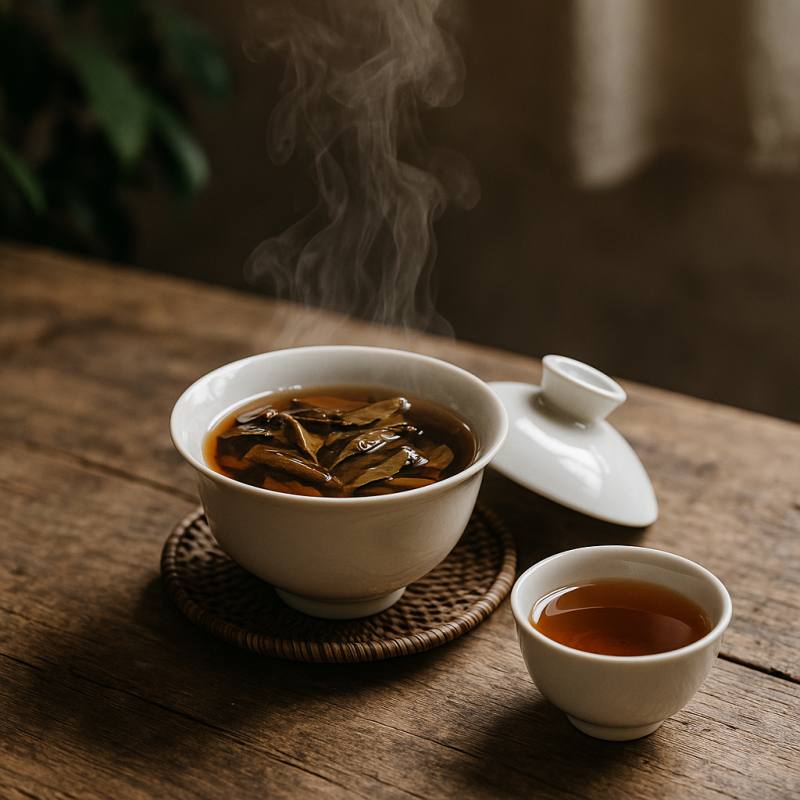
- A Small Brewing Vessel: The most common choices are a “gaiwan” (a lidded bowl) or a small teapot, typically made of Yixing clay or porcelain. A capacity of 80-150ml is ideal for solo or small group sessions. Yixing clay pots are porous and are best dedicated to a single type of tea (e.g., one pot for Sheng, one for Shou), as they absorb the tea’s character over time. A porcelain gaiwan is neutral and versatile, perfect for tasting different teas.
- A Fairness Pitcher (Gong Dao Bei, 公道杯): After steeping, the tea is decanted into this pitcher. This serves two purposes: it stops the infusion immediately, and it ensures that each cup poured from the pitcher has the exact same strength.
- Small Tasting Cups: Small cups encourage mindful sipping and allow the tea to cool to a suitable temperature more quickly.
- A Tea Tray or Bowl: A tray with a reservoir or a simple deep bowl is useful for catching spills and discarded water.
- A Tea Pick: Essential for breaking apart compressed cakes.
A Step-by-Step Brewing Guide (Gongfu Style)
- Measure and Prepare the Tea: Break off about 5-8 grams of your pu erh cake. The amount will depend on the size of your brewing vessel and your personal preference.
- Awaken the Leaves (Rinse): Place the leaves in your gaiwan or teapot. Pour hot water over them, just enough to cover, and immediately discard the water. This is not for drinking. This rinse serves to “awaken” the compressed leaves, wash away any dust, and begin to open them up. For Shou pu erh or older Sheng, some people prefer to do two quick rinses.
- The First Infusion: Refill the vessel with hot water. The water temperature is important. For most Sheng pu erh, a temperature just off the boil (around 95°C or 203°F) is a good starting point. For Shou pu erh and very old Sheng, a full rolling boil (100°C or 212°F) is often preferred (Té Company, 2020). Steep for a very short time—perhaps only 10-15 seconds.
- Decant and Serve: Pour the entire infusion into your fairness pitcher. Then, pour from the pitcher into the tasting cups.
- Taste and Appreciate: Before sipping, take a moment to appreciate the color of the liquor and its aroma. When you taste, let the tea wash over your entire palate. Notice the initial flavor, the texture or “mouthfeel,” and the lingering aftertaste (“hui gan”).
- Subsequent Infusions: For the next infusion, you can increase the steeping time slightly (e.g., 20 seconds). Continue to increase the time with each subsequent steep. A good quality chá pu erh can easily yield 8-15 infusions, with the character of the tea evolving beautifully with each cup.
Brewing Parameters Table
This table provides a starting point for your brewing experiments. Remember that these are guidelines, not rigid rules. Adjust them based on the specific tea and your own taste.
| Tea Type | Water Temp. | Rinse | 1st Steep | Subsequent Steeps |
|---|---|---|---|---|
| Young Sheng Pu Erh | 90-95°C (194-203°F) | 1 x 5s | 10-15s | +5-10s each |
| Aged Sheng Pu Erh | 95-100°C (203-212°F) | 1-2 x 5s | 5-10s | +5s each |
| Shou Pu Erh | 100°C (212°F) | 2 x 5s | 10-15s | +10s each |
Tasting Notes: What to Look for in Your Cup
Appreciating chá pu erh is a full sensory experience. As you drink, pay attention to several key aspects:
- Aroma: Smell the dry leaf, the wet leaf in the heated gaiwan, the aroma rising from the empty pitcher, and the aroma in your cup. Is it earthy, woody, fruity, floral, medicinal?
- Flavor: Beyond the primary notes, look for layers of complexity. Does the flavor change as it sits on your palate?
- Mouthfeel: Is the tea thin and watery, or is it thick, viscous, and soupy? Does it coat your mouth and throat?
- Hui Gan (Returning Sweetness): After you swallow, does a pleasant sweetness emerge and linger in your throat? This is a highly prized quality.
- Cha Qi (Tea Energy): This is a more subtle, subjective quality. Does the tea have an effect on your body? Does it feel warming, calming, or energizing? Does it focus your mind?
The journey into pu erh is one of continuous learning and discovery. Each tea is a new conversation, and each brewing session a new opportunity to listen.
Frequently Asked Questions about Chá Pu Erh
1. How much caffeine is in chá pu erh? Like all tea from the Camellia sinensis plant, pu erh contains caffeine. The exact amount can vary widely based on the specific tea plant, the processing, and how it is brewed. However, a common misconception is that dark teas like pu erh are always higher in caffeine. The “wo dui” fermentation process of Shou pu erh can actually reduce its caffeine content slightly. Generally, a cup of pu erh will have less caffeine than a cup of coffee, but more than many herbal infusions (Harney & Sons, 2017). Using the gongfu method with short steeps can help manage caffeine intake over a session.
2. What are the health benefits of pu erh tea? In traditional Chinese medicine, pu erh, particularly Shou pu erh, is considered a warming tea that aids digestion and helps to break down fats. Modern scientific research has begun to investigate these claims. Some studies suggest that the microbial fermentation process creates unique compounds, such as lovastatin (a natural statin), and that regular consumption may be associated with benefits for cholesterol management, gut health, and metabolic syndrome. However, these studies are often preliminary, and tea should be enjoyed as part of a balanced lifestyle rather than as a medical treatment.
3. Why is some pu erh so expensive? The price of a chá pu erh is determined by a combination of factors. The most significant is the quality of the raw material. Tea from ancient trees (gu shu) in famous mountains is extremely rare and commands a very high price. Age is another major factor; a well-stored Sheng pu erh from the 1980s can be a significant investment. Finally, brand reputation and market demand play a role. A famous factory production or a tea from a sought-after boutique producer will be more expensive than a generic tea.
4. Can I age my own pu erh tea? Yes, you can. Aging Sheng pu erh is a rewarding hobby for many tea lovers. The key is to provide the right environment. You need a space that is dark, free from strong odors, and has a relatively stable temperature and humidity (ideally 60-70%). A simple setup, sometimes called a “pumidor,” can be created using a cooler or cabinet with Boveda humidity control packs. It is a long-term project, but watching a tea transform over 5, 10, or 20 years under your care is a unique experience.
5. Is pu erh an acquired taste? For some, yes. The flavor profile of pu erh, especially the earthy, fermented notes of Shou pu erh, can be unfamiliar to a palate accustomed to green or black teas. Young Sheng pu erh can also be quite bitter and astringent. However, many people find they quickly come to appreciate and even crave these unique flavors. A good starting point might be a high-quality, clean-tasting Shou pu erh or a semi-aged Sheng that has already shed some of its youthful harshness. Don’t be discouraged if you don’t love the first one you try; the world of chá pu erh is vast and varied.
A Final Thought on the Journey
To engage with chá pu erh is to engage with a living history. It is a beverage that demands a measure of patience and mindfulness, rewarding the drinker not with an instant jolt, but with a slow unfolding of complexity. It connects us to a specific place on Earth, to ancient trees, and to the invisible world of microbes that work their quiet magic over years.
This guide has aimed to provide you with a map and a compass for your initial explorations. We have examined the core distinctions, the influence of time and place, and the practicalities of preparation. Yet, no amount of reading can substitute for the direct experience of tasting. The true learning happens when you sit down with a pot, a cup, and a few grams of leaves. Let your own palate be your guide. Be curious, be patient, and embrace the rich, earthy, and evolving world of this extraordinary tea.
References
Harney & Sons. (2017). Tea 101. Harney & Sons Fine Teas.
Té Company. (2020). How to brew loose leaf tea guide. https://tecompanytea.com/blogs/tea-atelier/how-to-brew-loose-leaf-tea
TeaSource. (2022). Types of tea: A user-friendly guide.